
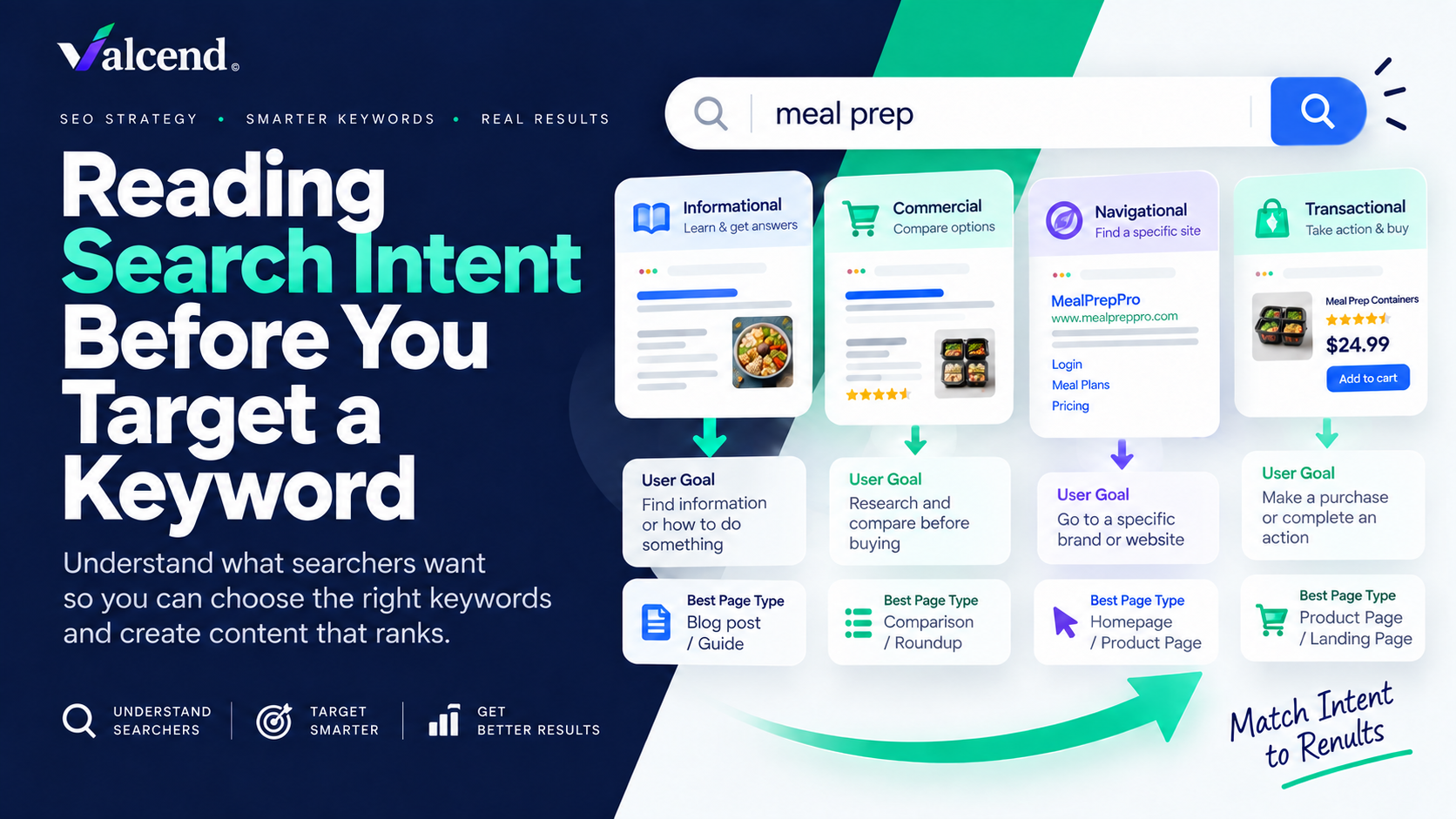
Search intent has become too important to reduce to a spreadsheet label
Keyword research tools can tell you that a query is informational, commercial, transactional, or navigational in seconds. That does not mean the targeting decision is finished.
Google explains that its ranking systems try to establish what a person is looking for by understanding the meaning and intent behind a query. It also says that relevance can depend on context such as location, language, and device, and that the signals carrying the most weight change according to the nature of the query. Google's explanation of how Search ranks results is useful here because it makes intent part of the ranking problem itself, not merely an SEO taxonomy.
The searcher's request is also becoming more expressive. Google reported in October 2025 that AI Mode queries were nearly three times longer than traditional searches. Google has also described AI Mode's query fan-out technique, which can issue multiple related searches across subtopics and data sources to assemble a response. These are Google-reported product behaviors, not a universal measure of all search activity, but they illustrate why one broad intent label can miss important parts of a complex request.
The familiar four intent categories remain useful shorthand. They are no longer enough to make the targeting decision.
What is the searcher trying to accomplish, what evidence supports that interpretation, and should my business invest in satisfying it?
What search intent actually means
Search intent is the goal a person is trying to accomplish when they search. The definition is simple. Real queries are not.
Someone searching accountant might want a definition, a local firm, a job, a professional qualification, software, or a specific company. Someone searching small business accountant Austin gives us much more evidence: a service category, customer type, and location.
Intent ambiguity
One short query can represent several jobs
The wording provides clues, but the live results are needed to test which interpretations search systems currently consider most relevant.
Google says its systems try to understand query meaning rather than relying exclusively on the literal words entered. Search results can also vary according to contextual factors and the type of information that appears most useful for the query. Google Search Central's guide to how Search works describes how those systems move from crawling and indexing to serving relevant results.
The four traditional intent types
| Intent | Searcher's likely goal | Example | Typical next need |
|---|---|---|---|
| Informational | Learn or answer a question | how does outsourced accounting work | Explanation, process, proof |
| Navigational | Reach a known destination | QuickBooks login | Direct access |
| Commercial | Evaluate alternatives | best accounting firms Austin | Comparison, evidence, differentiation |
| Transactional | Complete an action | hire small business accountant | Service detail, pricing context, contact |
This model is still useful, but the category describes only the broad direction of the search. It does not fully describe what should rank. Two commercial queries can demand completely different experiences.
Why the four intent types are only the beginning
Modern keyword tools recognize this limitation themselves. Ahrefs' current guidance notes that a query can carry multiple intent types and treats local and branded intent as additional practical dimensions. Its help documentation states that intent labels are estimated from the Google results associated with a keyword and can contain more than one classification. Ahrefs' search-intent filtering documentation is explicit that these labels are based on observed SERP characteristics.
Semrush likewise states that its machine-learning intent classification uses factors such as words within the keyword, SERP features, and whether the query is branded. Its keyword-intent calculation documentation describes the label as a classification produced from these signals.
Use an SEO tool's intent label to accelerate research, not to replace judgment. A label is an interpretation of observable signals, not direct access to every searcher's motivation.
Your strategic task goes one level deeper. You need to determine the expected experience behind the query and whether your business can provide it credibly.
Why the live SERP matters more than the keyword wording alone
The current search results are one of the most useful sources of intent evidence available. Google explains that different searches can produce different search features and result types, including local results, images, videos, and other formats. The SERP therefore gives you observable evidence about the kinds of experiences Google's systems currently consider useful for a query.
SERP evidence
Read the result pattern before you choose the page
A simplified search-results view shows the signals that deserve attention. The interface below is illustrative, not a live Google capture.
If the top results are primarily service pages, product categories, comparisons, tutorials, videos, or local listings, that pattern should influence what you build. The SERP does not reveal the mind of every individual searcher. It reveals what Google's systems currently consider useful enough to present for that query.
Deciding the page format from the wording of the keyword without checking what is actually ranking. This often produces a well-written page that is structurally mismatched with the searcher's job.
Conventional keyword research versus intent-first targeting
| Dimension | Conventional approach | Limitation | Intent-first approach | Expected business effect |
|---|---|---|---|---|
| First filter | Search volume | Popularity does not establish relevance | Searcher job and business fit | Fewer wasted targets |
| Intent | Assign one category | Mixed intent gets oversimplified | Identify dominant and secondary intents | Better page alignment |
| SERP | Check competitors late | The intended page type may already be wrong | Inspect the live SERP before deciding to target | Higher relevance |
| Content | Create one page around one keyword | Encourages unnecessary duplication | Map keyword clusters to one meaningful search job | Clearer architecture |
| Local queries | Optimize copy for the location term | May ignore map-led behavior | Evaluate local SERP features and local eligibility first | Better local visibility |
| Reporting | Track rankings | Does not prove intent quality | Follow queries through downstream conversions | Better commercial decisions |
The Valcend Intent Evidence Loop
I recommend treating search intent as an evidence loop rather than a one-time classification. The process moves from the query to the live results, then through business and page fit, and finally back through real performance data.
Valcend framework
The Intent Evidence Loop
Intent becomes actionable when the searcher's job, the SERP, the business offer, and post-click behavior point in the same direction.
To make the process concrete, consider Accounting Experts, a mid-sized accounting firm in Austin, Texas. Fictitious name and illustrative data used for demonstration purposes. The firm offers bookkeeping, tax planning, payroll support, and outsourced accounting.
Step 1: Read the query language
Form an initial intent hypothesis from the words a searcher uses before the live SERP confirms or challenges it.
The query is evidence, even when it is incomplete. Look for modifiers that reveal the problem, desired outcome, audience, location, urgency, comparison stage, price sensitivity, brand preference, format, or recency requirement.
Consider this progression:
- accounting services
- accounting services Austin
- accounting services for startups
- best accounting services for startups Austin
The subject is similar. The task is not. The fourth query contains location, audience, category, and comparison language. That is enough to form a hypothesis, but not enough to decide the page.
Information to collect
- Exact query and close variants
- Modifiers and implied customer type
- Likely stage of decision
- Local or branded elements
- Plausible secondary interpretations
Useful sources include Google Search, Google Search Console, Google Ads Keyword Planner, Ahrefs, Semrush, customer interviews, CRM notes, and sales-call terminology. Google's Keyword Planner documentation explains how the tool can surface keyword ideas and historical metrics. Those numbers are demand indicators, not proof of intent.
Do not infer the final intent from modifiers alone. Use the wording to form a hypothesis that the live SERP must confirm or challenge.
Step 2: Inspect the live SERP
Determine which page types, formats, features, and angles currently satisfy the query in the market you intend to target.
Search the keyword in the relevant geography. For Accounting Experts, that means evaluating U.S. results and, for local keywords, Austin-specific results. Location matters because Google states that a user's context can influence which results are considered most relevant.
Read the first page as a pattern rather than a collection of competitors. Record the dominant result type, SERP features, recurring content angle, freshness, and local behavior.
What to record
- Result type: service page, homepage, product page, article, comparison, directory, forum, video, or tool.
- SERP features: local results, images, videos, shopping, AI-generated experiences, featured answers, or discussions.
- Repeated angle: the problems, proof, price, audience, or format the leading results repeatedly emphasize.
- Freshness: whether recently updated content appears to dominate.
If outsourced accounting Austin primarily produces provider service pages, Accounting Experts can reasonably consider a commercially oriented service page. If best outsourced accounting firms primarily produces independent comparison lists, the business may need third-party inclusion and authority rather than a self-authored page claiming to be "best."
This distinction can prevent months of misdirected content work.
Step 3: Resolve dominant and secondary intent
Convert the result pattern into a precise intent statement that guides the targeting decision.
Not every SERP has one clean purpose. You may see service pages, directories, comparison articles, and informational pages all sharing the first page. That is a mixed SERP.
Do not force mixed evidence into a false binary. Separate three things:
Intent statement
Write down what is dominant, secondary, and uncertain
A useful intent statement is more actionable than a single-letter intent label.
The strongest repeating job represented by the leading results.
Another meaningful job Google is also serving for the same query.
Evidence that the result mix is fragmented, unstable, or open to more than one useful experience.
Ahrefs has long recommended examining SERP composition and result stability when interpreting search intent. Its search-intent methodology notes that ranking volatility can be a clue that the dominant interpretation is unclear or changing.
If one page type and customer job clearly dominate, build for that dominant intent. If the SERP is genuinely mixed, ask whether your site has a credible advantage within one of the represented result types. If not, lower the keyword's priority.
A useful final statement might read: "Primarily commercial and local. Searchers appear to be choosing an Austin accounting provider, while directories serve a secondary comparison need."
Step 4: Test business fit
Determine whether satisfying the searcher's need is valuable enough to the business to deserve SEO investment.
This is the point where search-intent analysis becomes business strategy. Ask whether the searcher resembles a customer you want, whether you actually offer what the person needs, whether your website can satisfy the intent credibly, whether a logical next action exists, and whether the potential customer value justifies competing for the query.
Consider free bookkeeping spreadsheet. Accounting Experts could publish a template and potentially attract informational traffic. Whether that deserves priority depends on the path from that audience to the firm's paid services.
Compare it with outsourced bookkeeping services Austin. Even if demand is lower, the query may fit the firm's service, geography, and ideal customer much more closely.
Target prioritization
Search demand and intent fit answer different questions
Demand indicates how often the market may express a need. Intent and business fit determine whether winning that demand would be strategically useful.
Strategic niche. Often valuable when customer quality or lifetime value is strong.
outsourced bookkeeping AustinPriority when the business can satisfy the intent and realistically compete.
small business accountant AustinUsually deprioritize unless the topic supports another strategic objective.
accounting terms glossaryPotential awareness play, but not automatically a commercial priority.
free bookkeeping spreadsheetConceptual model: search opportunity increases from left to right; intent and business fit increase from bottom to top.
The distinction I make is this: search relevance tells us whether the business belongs in the conversation. Business potential tells us whether winning that conversation is worth the investment.
For the broader economic test, see Choosing Keywords That Match Demand and Business Goals.
A target should normally pass three tests: the business can satisfy the need, the searcher can plausibly become valuable, and the site has a credible experience with which to compete.
Step 5: Map the intent to a page and keyword cluster
Choose one search experience for each meaningful customer job instead of creating one page for every keyword variation.
Two phrases can look different while serving the same intent. Keyword clustering helps by grouping terms that appear to belong to the same page or search job.
Semrush describes a clustering approach that compares organic-result similarity when grouping keywords, while Ahrefs also discusses SERP similarity as a practical way to decide whether terms should be served by one page or separate pages. This is useful because Google's current result overlap gives you evidence about whether two phrases are effectively asking for the same experience.
For example, outsourced accounting Austin, Austin outsourced accounting services, and outsourced accountants Austin may belong on one service page if they consistently return similar URLs. Outsourced accounting vs in-house accounting likely serves a different job and deserves a different page.
| Searcher job | Likely experience | Conversion logic |
|---|---|---|
| Learn a concept | Guide or explainer | Move to a related next question or service when appropriate |
| Solve a problem | Tutorial, tool, checklist | Demonstrate expertise and offer a relevant next step |
| Compare options | Comparison or category page | Help evaluate alternatives credibly |
| Evaluate a provider | Service page, proof, reviews, case evidence | Reduce uncertainty and make contact easy |
| Visit nearby | Local landing page and Business Profile | Support calls, directions, appointments, or visits |
| Complete a transaction | Product or service conversion page | Remove friction from action |
Build one page per meaningful search job, not one page per keyword variation. Use SERP overlap to help determine which variations belong together.
Once the mapping is clear, the next step is page execution. See How to Optimize a Page Around One Search Opportunity for the page-level workflow.
Step 6: Validate intent with real performance data
Use query, onsite, lead-quality, and sales evidence to confirm whether the audience attracted by the page matches the intent you planned for.
Intent analysis does not end when the page is published. Google Search Console's Performance report can show the queries producing impressions and clicks for a page. Google Analytics can show what happens after those visitors arrive. Google recommends using the systems together because they measure different parts of the journey.
Measurement
From intent hypothesis to revenue evidence
Follow the searcher from the query through the website and into the customer record where your measurement stack allows it.
Imagine a page begins gaining traffic for bookkeeping template even though the intended strategy was outsourced bookkeeping Austin. That tells you something. The page may be relevant to an informational audience but misaligned with the commercial audience the business wanted.
More traffic would not automatically fix the problem.
Metrics to inspect
- Search Console: impressions by query, clicks, CTR, query-to-page relationship, and shifts in visibility.
- Analytics: organic landing-page sessions, engagement, key events, and conversion rate.
- CRM and sales data: lead quality, appointments, opportunities, customers, and revenue where attribution is reliable.
Search Console clicks and Google Analytics sessions are calculated differently and should not be expected to match exactly. Google recommends interpreting the systems together rather than treating a discrepancy as proof that one platform is wrong.
Outputs versus business outcomes
Intent work creates useful artifacts, but a clean spreadsheet is not the business result. The distinction matters because each metric should support a decision.
| Metric | Classification | Decision it supports |
|---|---|---|
| Keywords researched | Activity | How broad was the opportunity discovery? |
| Keywords assigned intent | Output | Which queries require deeper validation? |
| SERPs reviewed | Output | How much live-result evidence supports the targeting plan? |
| Keyword clusters created | Output | Which queries should one page serve together? |
| Rankings | Diagnostic | Is the page gaining competitive visibility for the intended query family? |
| Impressions | Diagnostic | Is Google associating the page with the expected demand? |
| Click-through rate | Diagnostic | Does the search presentation earn visits from the exposed audience? |
| Qualified leads | Business KPI | Is the attracted audience commercially useful? |
| Appointments / opportunities | Business KPI | Does organic demand progress through the buying process? |
| Revenue | Business KPI | What financial value can reasonably be attributed or associated with organic acquisition? |
An intent strategy is failing if the classifications look tidy but the resulting pages consistently attract the wrong audience.
When to reconsider your interpretation
Search intent is not permanent. Revisit the assumption when the SERP composition changes materially, rankings improve while CTR remains weak, traffic rises while qualified conversions do not, a page starts ranking for a different query family, local or AI features alter the search experience, or two pages repeatedly compete for the same searches.
Google's SEO Starter Guide cautions that some changes can be reflected quickly while others can take several months, and generally recommends allowing at least a few weeks before judging whether a change had an effect.
That does not mean waiting indefinitely. If a page steadily gains visibility but attracts a clearly unsuitable audience, the problem may not be patience. It may be intent.
The final targeting decision
Search volume tells you how often a market may express demand. Keyword difficulty tells you something about the competitive environment. Neither tells you whether your business should participate.
Search intent connects the keyword to the human decision behind it.
The strongest opportunities are usually those where the searcher's need, the live results, the page you can build, and the business outcome all point in the same direction.
Read intent before you decide that a keyword deserves investment. Volume and competition become meaningful only after winning the search would be useful.
For the broader business context, read SEO Explained: How Organic Search Creates Business Value.
Search strategy built around business value
Need help deciding which search demand deserves investment?
At Valcend, I evaluate search demand alongside customer intent, business value, technical feasibility, content requirements, and measurement. The objective is not to create the largest keyword list. It is to identify which searches deserve priority and build the right experience around them.
Book a consultation
Emilio Tinoco
Emilio Tinoco is the Founder and Digital Marketing Strategist at Valcend. He has more than eight years of digital marketing experience across SEO, paid media, lead generation, analytics, measurement, and business-to-consumer marketing. His approach begins with business objectives and customer demand before determining which channels, keywords, content, and technical changes deserve priority. Through Valcend, Emilio helps businesses connect search visibility to qualified opportunities and measurable growth rather than treating rankings or traffic as isolated indicators of success.
More about EmilioMethodology and sources
This article was researched and updated on September 6, 2026. Research prioritized current Google Search and Search Console documentation, Google product information relating to AI search behavior, official product documentation for keyword-research tools, current SEO-industry methodology, and practitioner discussions used only to identify common implementation concerns.
Statements from Google about AI Mode usage represent Google's own product data and should not be generalized to all search behavior. Accounting Experts is fictitious, and its queries and commercial scenarios are illustrative rather than reported client results.
The sections covering AI search, SERP features, and keyword-tool capabilities should be reviewed within six months because these products and interfaces continue to change.
References
- Automatically generating and ranking results. Google Search. Current documentation. Direct source. Accessed September 6, 2026.
- In-depth guide to how Google Search works. Google Search Central. Updated December 18, 2025. Direct source. Accessed September 6, 2026.
- AI Mode is now available in more languages and locations around the world. Google. October 7, 2025. Direct source. Accessed September 6, 2026.
- AI in Search: Going beyond information to intelligence. Google. May 20, 2025. Direct source. Accessed September 6, 2026.
- Keyword Intent: What It Is and How to Use It in Your SEO Strategy. Ahrefs. March 13, 2026. Direct source. Accessed September 6, 2026.
- How to filter keywords based on Search intent and other useful attributes. Ahrefs Help Center. Direct source. Accessed September 6, 2026.
- How is Keyword Intent calculated? Semrush Knowledge Base. Direct source. Accessed September 6, 2026.
- Use Keyword Planner. Google Ads Help. Direct source. Accessed September 6, 2026.
- Use Semrush's keyword clustering tool to build your strategy. Semrush. Direct source. Accessed September 6, 2026.
- Performance report: Search results. Google Search Console Help. Direct source. Accessed September 6, 2026.
- Using Search Console and Google Analytics data for SEO. Google Search Central. Direct source. Accessed September 6, 2026.
- SEO Starter Guide. Google Search Central. Updated December 10, 2025. Direct source. Accessed September 6, 2026.