
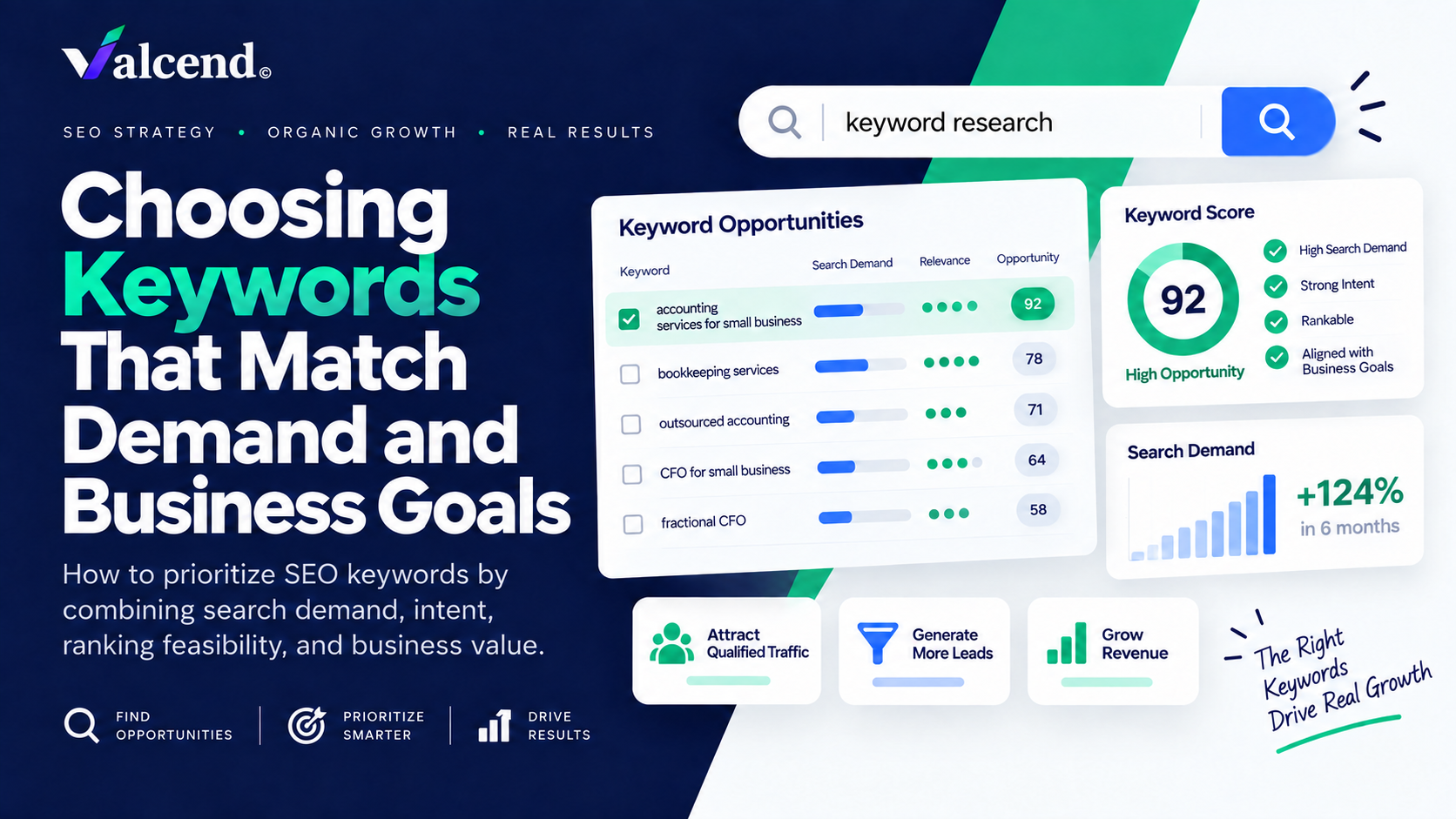
A keyword can look attractive and still be the wrong investment
Keyword research gives marketers more information than ever. The hard part is no longer finding enough keywords. It is deciding which ones deserve resources.
A single export can contain estimated search volume, traffic potential, intent, difficulty, cost per click, SERP features, competitor positions, and hundreds of related terms. Current keyword-selection guides from Ahrefs and Semrush already recommend considering several of these signals together. The practical problem begins when the signals disagree. Ahrefs' keyword-selection guide and Semrush's 2026 guide both illustrate this multi-factor approach.
Imagine one keyword receives substantial monthly search demand but has weak relevance to what you sell. Another receives fewer searches but describes exactly the service your most valuable customers need. A third looks commercially attractive but is dominated by competitors your current website is not yet equipped to challenge.
Which should come first?
The answer requires understanding what each metric actually tells you.
Four signals, four questions
Keyword metrics are useful because they answer different questions
Is there measurable interest in this query or topic?
What is the searcher trying to accomplish?
How much work may be required to earn meaningful visibility?
Would winning this demand help the business achieve something important?
Google Keyword Planner is useful for keyword ideas and historical search estimates, but its Competition field refers to advertiser competition, not organic SEO difficulty. Google's Keyword Planner documentation explains the distinction. Google Trends answers a different question again: its values are normalized relative-interest data rather than absolute monthly search counts. Google's Trends methodology documents how that data is sampled and normalized.
Creating a weighted spreadsheet formula so elaborate that the score replaces judgment. A prioritization model should expose the decision, not hide it.
The conventional shortcut versus a business-first approach
| Dimension | Conventional shortcut | Limitation | Recommended approach | Business effect |
|---|---|---|---|---|
| Demand | Highest volume wins | Popularity can be commercially weak | Evaluate meaningful demand | Better audience fit |
| Intent | Transactional gets priority | Informational demand can influence valuable decisions | Match intent to the customer journey | Broader qualified visibility |
| Difficulty | Lowest KD wins | Easy terms may have little value | Compare difficulty with opportunity | Better resource allocation |
| CPC | High CPC means valuable | Paid-auction economics are not your profitability | Use CPC only as supporting evidence | Less false confidence |
| Reporting | Ranking achieved | A ranking may produce weak traffic or leads | Measure downstream outcomes | Commercial accountability |
The Valcend Demand-to-Value Filter
Rather than assigning one universal priority score, I recommend moving each opportunity through five questions in sequence.
Original Valcend framework
From keyword idea to investment decision
Each filter answers a reason the opportunity may or may not deserve resources.
Consider Accounting Experts, a mid-sized accounting firm in Austin, Texas. Fictitious business used for illustrative purposes.
The firm is evaluating three search themes: small business accountant Austin, outsourced accounting services, and free bookkeeping template. All may have demand. They do not have equal strategic value.
1. Anchor the keyword to a business outcome
Before comparing volume, decide what the business wants more of.
Accounting Experts might prioritize recurring outsourced-accounting engagements rather than one-time consumer tax filings. That changes the keyword strategy immediately.
- Which services are growth priorities?
- Which customers are most valuable?
- Which markets can the business serve?
- What conversion should organic traffic ultimately influence?
- Does the business have capacity for additional demand?
If you cannot identify the useful business outcome behind a keyword, do not prioritize it yet.
Measurable output: a short list of priority services, audiences, and customer actions that SEO is expected to support.
2. Verify meaningful search demand
Now evaluate whether customers actually search for the problem. Useful sources include Google Keyword Planner, Google Trends, Google Search Console, Ahrefs, Semrush, and paid-search term data when available.
Keyword Planner can provide keyword ideas and estimates of average monthly searches. Google Trends can help reveal whether relative interest is growing, declining, seasonal, or geographically concentrated.
For an established website, Search Console is particularly useful because its data reflects queries that already generated visibility for the business. Google introduced Query groups in Search Console Insights in 2025 to help site owners interpret groups of similar searches rather than treating every phrasing as a separate strategic problem. Google's Query groups announcement explains that the groups can combine different formulations representing similar user interests.
One need, many queries
The customer need is often a better planning unit than one exact keyword
Suppose free bookkeeping template has much more search demand than outsourced accounting services Austin. That establishes a difference in demand. It does not settle the priority decision.
3. Confirm intent and page fit
The next question is what the searcher expects to receive.
Inspect the live search results. If Google mainly returns local accounting firms and service pages for small business accountant Austin, a properly designed service page may fit naturally. If free bookkeeping template produces downloadable spreadsheets and free tools, the firm would need to satisfy a very different job.
Google documents multiple systems used to understand meaning and relevance, including BERT, neural matching, and RankBrain. That is one reason keywords are better treated as expressions of a need than strings that must be repeated mechanically on a page. Google's ranking systems guide describes those systems.
For the full analysis process, see Valcend's guide to reading search intent before targeting a keyword.
Target the need only if you can create the type of page the searcher actually needs.
Measurable output: an intent-to-page map showing which search themes belong on service pages, guides, comparison pages, local experiences, or other appropriate assets.
4. Estimate the ranking investment
A commercially attractive keyword can still be the wrong immediate target when the competitive gap requires resources the business cannot justify yet.
Evaluate the strength and relevance of ranking pages, referring domains, your existing topical coverage, internal linking, technical readiness, local prominence where appropriate, and any current rankings or impressions.
Google emphasizes that rankings are produced through multiple systems and signals, so no single third-party difficulty score captures the entire competitive environment.
Valcend's guide to estimating ranking difficulty covers this analysis in more depth.
Do not ask only, “Can we rank?” Ask, “What would we need to build to become competitive, and what else could those resources accomplish?”
Measurable output: a realistic investment category such as low, moderate, or substantial, supported by observable competitive evidence rather than a promised ranking probability.
5. Prioritize by expected business contribution
Now bring the evidence together.
| Keyword theme | Demand | Business fit | Intent fit | Ranking effort | Decision |
|---|---|---|---|---|---|
| small business accountant Austin | Moderate | Very strong | Strong | Moderate | Priority |
| outsourced accounting services | Moderate | Very strong | Strong | High | Strategic |
| free bookkeeping template | High | Weak | Informational | Moderate | Supporting |
Illustrative assessment only. No search-volume or client-performance figures are implied.
Executive prioritization
Business value should change how ranking effort is interpreted
Strong candidate for current investment.
PriorityWorth building toward when the opportunity is strategically important.
StrategicUseful when it supports education, authority, links, or customer progression.
SupportingWeak return relative to the resources required.
DeprioritizeThe free template may still deserve content if it reaches the right audience, earns links, supports another page, or introduces qualified prospects to the business. But traffic potential alone does not make it the first investment.
I recommend four classifications:
- Priority: strong demand, business fit, intent fit, and a realistic path to visibility.
- Strategic: high business value, but the site needs greater authority, depth, or supporting assets first.
- Supporting: useful for awareness, education, authority, or customer progression, but not a primary revenue target.
- Deprioritize: the strategic connection is too weak to justify the resources.
Measure the outcome, not just the ranking
Keyword selection is a hypothesis. Performance data tells you whether the hypothesis was useful.
From search opportunity to business result
The useful measurement chain continues after the click
| Metric | Role | Decision it supports |
|---|---|---|
| Keywords targeted | Output | Was the strategy implemented? |
| Pages published | Output | Was the required asset created? |
| Impressions | Diagnostic | Is the page gaining search visibility? |
| Rankings | Diagnostic | Is competitive position improving? |
| Organic clicks | Diagnostic | Does visibility generate visits? |
| Qualified leads | Business KPI | Is the audience commercially relevant? |
| Appointments / opportunities | Business KPI | Does the demand match the offer? |
| Revenue | Business KPI | Is organic visibility contributing financially? |
Google Analytics supports attribution reporting because customer journeys can contain several channel interactions before a conversion. Google Analytics' attribution documentation describes how credit can be assigned across touchpoints.
That means an informational keyword should not automatically be dismissed because it rarely receives last-click credit. It may assist a decision that later closes through direct traffic, email, paid media, a phone call, or sales follow-up.
Attribution remains imperfect. Communicate that uncertainty rather than assigning revenue precision the data cannot support.
Choose the opportunity, not the biggest number
Good keyword selection is not about finding one metric that predicts success.
Search demand tells you whether people are looking. Intent tells you what they want. Difficulty helps estimate what earning visibility may require. Business context determines whether winning that visibility matters.
The strongest SEO investments occur when those signals reinforce one another. When they do not, business value should shape the decision rather than allowing a large search-volume number or attractive difficulty score to make it automatically.
That is how keyword research becomes resource allocation rather than spreadsheet management.
Search strategy built around business value
Need help deciding which keywords deserve investment?
At Valcend, I evaluate search demand, customer intent, ranking feasibility, content requirements, and business value together. The goal is not to target more keywords. It is to determine which search opportunities deserve resources and what winning them should accomplish for the business.
Book a consultation
Emilio Tinoco
Emilio Tinoco is the Founder and Digital Marketing Strategist at Valcend. He has more than eight years of experience across SEO, paid media, lead generation, analytics, measurement, and business-to-consumer marketing. His approach starts with business objectives and customer demand before determining which keywords, content, technical improvements, and acquisition opportunities deserve investment. Through Valcend, Emilio helps businesses connect search visibility to qualified customer opportunities and measurable growth.
More about EmilioMethodology and sources
This article was researched and updated on September 6, 2026. Research prioritized current Google Search, Search Console, Google Ads, Google Trends, and Google Analytics documentation. Current keyword-selection resources from established SEO publishers were reviewed for competitive analysis. Recent practitioner discussions were used only to identify implementation concerns, not as statistical evidence.
Accounting Experts and its prioritization examples are fictitious and illustrative. The sections concerning Search Console features, keyword tools, and AI-assisted query analysis should be reviewed within six months because these products continue to change.
References
- How to Find and Choose the Right Keywords for SEO. Joshua Hardwick, Ahrefs. Updated August 29, 2024. Direct source. Accessed September 6, 2026.
- How to Choose Keywords for SEO + AI Search (5 Ways). Vlado Pavlik, Semrush. January 28, 2026. Direct source. Accessed September 6, 2026.
- Use Keyword Planner. Google Ads Help. Current documentation. Direct source. Accessed September 6, 2026.
- FAQ about Google Trends data. Google Trends Help. Current documentation. Direct source. Accessed September 6, 2026.
- Introducing Query groups in Search Console Insights. Moshe Samet, Google Search Central. October 27, 2025. Direct source. Accessed September 6, 2026.
- A Guide to Google Search Ranking Systems. Google Search Central. Updated December 10, 2025. Direct source. Accessed September 6, 2026.
- Get started with attribution. Google Analytics Help. Current documentation. Direct source. Accessed September 6, 2026.