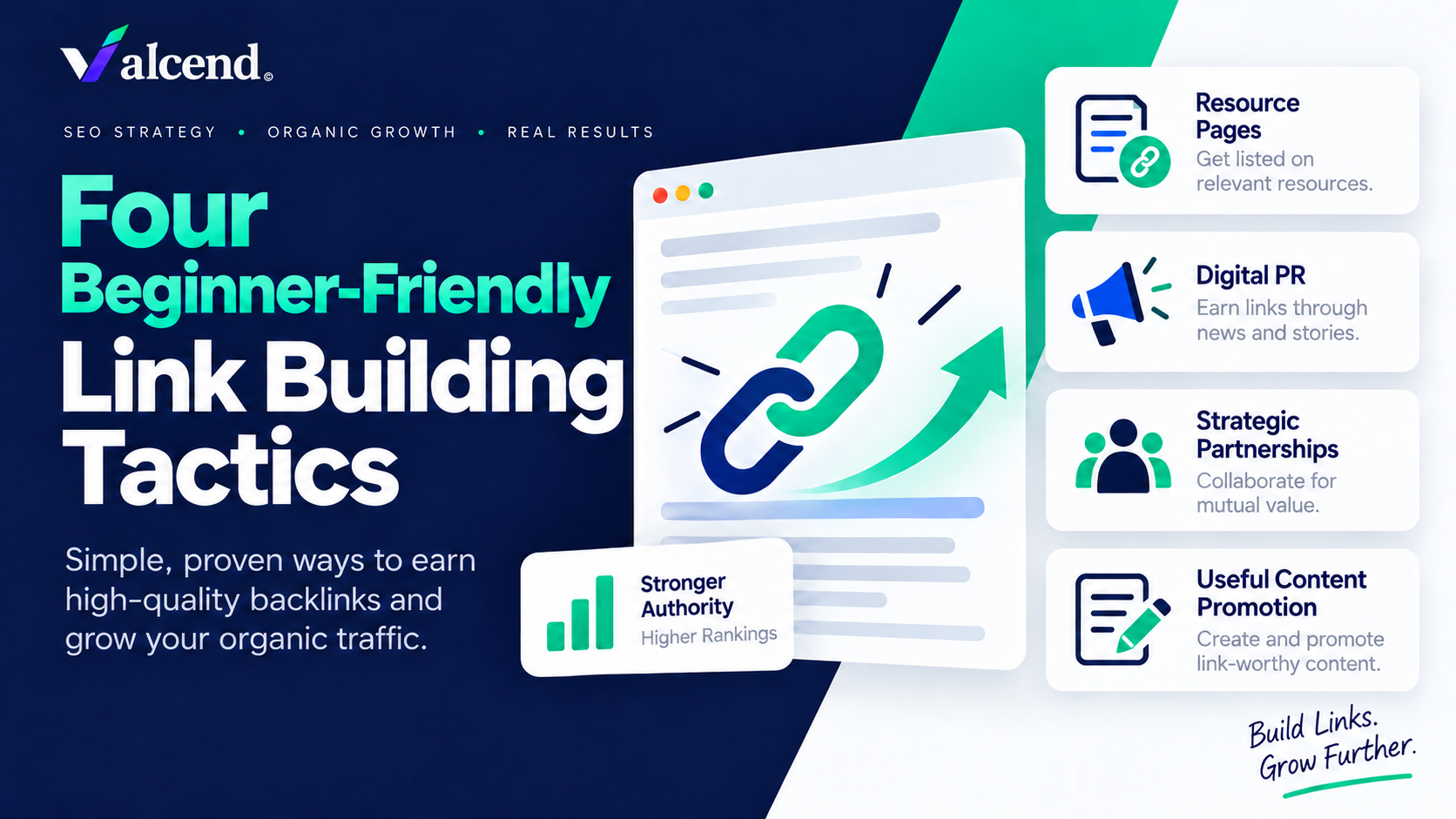
Link building gets harder when you begin with the link.
Beginners often encounter link building as a numbers problem: find a list of websites, send outreach, acquire a target number of backlinks, and repeat. The process is easy to count, but it starts with the output instead of the reason a useful website would create the reference.
Google still uses links to understand relationships and relevance between pages, and PageRank remains part of Google's core ranking systems. At the same time, Google's spam policies prohibit manipulative practices such as purchasing ranking links, excessive exchanges, automated link creation, and optimized links created primarily to influence rankings.
So the better beginner question is not “Where can I get a backlink?” It is “What legitimate reason would this website have to reference us?”
Four editorial reasons
Start with the publisher's need, then choose the tactic
A curated page needs a genuinely helpful guide, tool, reference, or dataset.
The publisher already mentions the business, expert, research, or asset but not the source.
A useful page sends readers to a resource that no longer works and needs a legitimate substitute.
A publication needs credible practitioner insight that improves its information for readers.
The Valcend Relevance-First Link Sprint
Before doing outreach, choose one page that matters to the business and identify the editorial reason another site could reasonably reference it. Only then select a tactic.
Original framework
Five steps from business priority to earned reference
Consider Accounting Experts, a mid-sized accounting firm in Austin, Texas. Fictitious business used for illustrative purposes. Its goal is stronger visibility around small-business accounting services. Instead of prospecting random domains, it looks for situations where its information or expertise would improve something already published.
Suggest a genuinely useful resource
Earn a reference from a page that already exists to guide readers toward useful external resources.
Resource pages are a logical starting point because they are designed to point outward. Ahrefs' resource-page link building guide describes the basic process as finding relevant resource pages, vetting them, and suggesting a useful addition.
Accounting Experts might maintain a Texas Small-Business Accounting and Tax Deadline Guide based on primary government sources. It could then identify entrepreneurship programs, local business organizations, or small-business education sites that already curate Texas resources.
The outreach should explain where the resource fits and what it adds. The publisher should be able to understand the benefit without knowing anything about your SEO goals.
Pitching the homepage when the resource page clearly exists to link to guides, tools, datasets, or references.
Use resource-page outreach when you already have something that belongs naturally in a curated resource collection.
Relevant editorial resource links.
Referral exposure and external support for pages tied to important search opportunities.
Reclaim an existing brand mention
Turn recognition the business has already earned into useful attribution when a link improves verification or further reading.
An unlinked mention occurs when a site refers to your company, an employee, research, product, image, or quotation without linking to the relevant source. The main advantage is that the editorial relationship already exists.
Imagine an Austin business organization writes that Accounting Experts recommends reviewing monthly cash flow before expanding payroll. If the recommendation came from an original guide or interview, linking the attribution could help readers verify or explore the source.
Search for exact brand names, expert names, proprietary research titles, branded resources, and distinctive quotations. Brand monitoring can automate part of the process, but manual search is often enough for smaller businesses.
Not every mention deserves a backlink. Request attribution only when the link genuinely improves the reference for the reader.
Use mention reclamation when recognition already exists and linking makes the source easier to verify or explore.
Relevant unlinked mentions converted into attributable references.
Stronger attribution, referral opportunity, and external recognition.
Replace a broken reference
Solve a real problem on another page by replacing a dead external resource with a relevant working source.
Broken-link building starts with a page that no longer works but still has links pointing to it. The useful process is to understand what disappeared, create or identify a legitimate replacement, and contact publishers whose readers are being sent to the dead resource. Ahrefs documents the mechanics in its broken-link building guide.
For Accounting Experts, imagine a Texas entrepreneurship guide links to an accounting checklist that now returns an error. If Accounting Experts maintains a current resource covering the same need, it may be a suitable replacement.
The fit matters. A page is not a replacement merely because it is on a related topic.
Sending automated “your link is broken” outreach when the suggested replacement does not actually satisfy the same reader need.
Use broken-link outreach only when your resource could genuinely replace what disappeared.
Relevant broken references replaced with working editorial sources.
New referral and search visibility from a placement that also improves the publisher's page.
Contribute useful expertise
Use specialist knowledge to improve relevant third-party content rather than treating guest contributions as backlink containers.
Accounting Experts could contribute informed commentary on deciding when bookkeeping should be outsourced, preparing financial information for a lender, or accounting considerations when hiring a first employee.
The strongest pitch begins with the editorial gap: the specific topic, why your experience is relevant, one useful observation, and evidence or explanation that strengthens it. If the publisher independently decides a link to your profile, research, biography, or supporting resource helps readers, the reference follows naturally from the contribution.
Google's spam policies make the boundary important. Legitimate editorial contributions are not automatically problematic, but optimized links inside paid or scaled articles created primarily for ranking manipulation can violate policy. Paid placements should be qualified with rel="sponsored" or nofollow as appropriate.
Contribute expertise when the information would still be worth publishing if the backlink were removed.
Relevant expert citations, quotations, contributions, and references.
External authority, referral exposure, brand discovery, and potential organic visibility support.
Choose the tactic that matches what you already have
You do not need to run all four tactics at once. Start with the advantage the business already possesses.
Tactic selector
Match the situation to the outreach method
Best when the asset already belongs in curated resource collections.
Best when recognition exists but attribution can be improved.
Best when your page genuinely solves the same reader need.
Best when your expertise improves a publication independently of the backlink.
Before outreach, write one sentence answering: “Why is this useful for their reader?” If the answer is mostly about improving your rankings, the opportunity is probably weak.
Measure more than the backlink
A backlink is an output of the work, not the final business outcome. Track whether the campaign creates relevant recognition and whether the pages you are supporting become more visible to useful audiences.
Measurement chain
From outreach activity to business evidence
Google Search Console's Links report can show linking sites and heavily linked pages, although Google describes it as a sample rather than a complete backlink inventory. Its Performance report can then show impressions and organic clicks for the pages you are trying to strengthen.
Google Analytics can help evaluate referral visits, while a CRM or sales system should determine whether those visits or the associated organic visibility produce meaningful prospects.
Do not assume a ranking increase following one backlink proves that the link caused it. Google's ranking systems use many signals, and competitors, content, internal links, and search results change simultaneously.
Start with the reason, not the backlink
Beginner link building does not require dozens of tactics. Look for four simple situations: a useful resource belongs in a curated list, an existing mention deserves attribution, a dead reference needs a replacement, or a publication can benefit from your expertise.
Each begins with something useful for the other website. That is the habit worth learning first.
Once you understand why legitimate references are created, advanced link-building tactics become much easier to evaluate.
Build authority around the opportunities worth winning
Need help deciding where link building deserves investment?
At Valcend, I evaluate backlink opportunities alongside search intent, page quality, ranking difficulty, customer relevance, and business potential. The goal is not to manufacture a monthly link quota. It is to determine which external references can strengthen the search opportunities that actually matter to the business.
Book a consultation
Emilio Tinoco
Emilio Tinoco is the Founder and Digital Marketing Strategist at Valcend. He has more than eight years of experience across SEO, paid media, lead generation, analytics, measurement, and business-to-consumer marketing. His approach begins with business goals and customer demand before determining which keywords, content, technical improvements, acquisition channels, and authority-building activities deserve investment. Through Valcend, Emilio helps businesses connect search visibility to qualified customer opportunities and measurable growth.
More about EmilioMethodology and sources
How this article was researched
This article was researched on September 6, 2026. Research prioritized current Google Search Central documentation on links, ranking systems, spam policies, paid-link qualification, and Search Console reporting. Current material from Ahrefs, Semrush, and Backlinko was reviewed to understand common beginner tactics and where broad tactic lists can create unnecessary complexity.
Community discussions were used only to identify implementation concerns such as weak outreach response and confusion around paid placements. They were not used as ranking evidence. Accounting Experts and its examples are fictitious and illustrative. Google link policies and third-party tool capabilities should be reviewed within six months.
References
Primary and supporting sources
- SEO Link Best Practices for Google. Google Search Central. Updated December 10, 2025. Direct source. Accessed September 6, 2026.
- A Guide to Google Search Ranking Systems. Google Search Central. Updated December 10, 2025. Direct source. Accessed September 6, 2026.
- Spam Policies for Google Web Search. Google Search Central. Current September 2026 documentation. Direct source. Accessed September 6, 2026.
- Qualify Your Outbound Links to Google. Google Search Central. Updated December 10, 2025. Direct source. Accessed September 6, 2026.
- Links Report. Google Search Console Help. Current documentation. Direct source. Accessed September 6, 2026.
- Performance Report: Search Results. Google Search Console Help. Current documentation. Direct source. Accessed September 6, 2026.
- Link Building for SEO: The Beginner's Guide. Tim Soulo, Ahrefs. Current guide. Direct source. Accessed September 6, 2026.
- Resource Page Link Building: The Only Guide You Need. Joshua Hardwick, Ahrefs. March 2, 2023. Direct source. Accessed September 6, 2026.
- Broken Link Building: The Complete Guide. Joshua Hardwick, Ahrefs. May 23, 2022. Direct source. Accessed September 6, 2026.
- 10 Link Building Strategies That Still Work in 2026. Semrush. April 22, 2026. Direct source. Accessed September 6, 2026.