
Link analysis makes backlinks look easy to compare. A tool can show Domain Rating, Authority Score, referring domains, anchor text, link attributes, and estimated traffic. Those metrics are useful. They still cannot tell you, by themselves, whether one particular backlink deserves your time or money.
Google does not publish a universal backlink-quality score. Its current ranking documentation says Google uses several systems to understand how pages link to one another and which pages may be useful, and that PageRank remains part of its core ranking systems. Google also says its ranking systems are predominantly page-level and rely on many signals. Google's ranking-systems documentation is therefore more nuanced than the idea that a high domain score automatically means a high-value link.
This creates practical conflicts. Is a link from a highly relevant specialist site more useful than one from a much larger but loosely related publication? Can a qualified nofollow link still have business value? Is a weak link the same thing as a spammy one?
The answer depends on why the link exists, the context around it, the credibility of the source, where it points, and what it can realistically contribute.
What backlink quality actually means
Google says links help it discover pages and understand relevance. That establishes that links matter. It does not establish a public formula for assigning a value to every backlink. Google's link best practices focus on crawlable links, useful anchor text, and contextual clarity rather than a third-party authority threshold.
Ahrefs makes a similar distinction in its own guidance. It evaluates backlink quality through concepts such as authority, relevance, anchor text, placement, and destination, while acknowledging that the exact way search engines value links is not public. Ahrefs' backlink-quality documentation is useful as an analytical framework, not as Google's disclosed scoring model.
Backlink metrics help you investigate a link. Context determines whether the opportunity makes strategic sense.
Why a high domain score is not enough
Consider Accounting Experts, a mid-sized accounting firm in Austin, Texas. Fictitious business used for illustrative purposes.
It has two possible link opportunities. Opportunity A is a large general publication with an illustrative DR of 81, a loosely related entrepreneurship article, and a paid link insertion. Opportunity B is a smaller Texas small-business publication with an illustrative DR of 38, an article specifically about financial resources for Austin companies, and an independent editorial reference to the firm's tax-deadline resource.
Illustrative comparison
High domain score versus high contextual relevance
Domain metrics can help screen prospects. They do not settle the value of the final placement.
- Loose topical connection
- Paid insertion
- Limited accounting context
- Audience fit is uncertain
- Specific financial-resource context
- Independent editorial citation
- Relevant Austin business audience
- Destination directly supports the reference
A spreadsheet sorted only by DR would choose Opportunity A. A contextual review may strongly prefer Opportunity B.
The Valcend Link Value Test
Before pursuing a backlink, I recommend evaluating five questions in order.
Original Valcend framework
The Valcend Link Value Test
Backlink value emerges from the entire reference, not one metric.
Is there a legitimate editorial reason for the reference?
Do the site, page, and surrounding passage make sense?
Does the publication appear legitimate, useful, and selective?
Evaluate anchor, location, attribute, and target page together.
Search visibility, referral discovery, qualified demand, or brand value.
1. Ask why the link exists
Start with the editorial reason. A strong link usually exists because the linked page gives the publisher something useful to reference: evidence, original research, expert commentary, a tool, attribution, or a resource that helps the reader continue the task.
For Accounting Experts, an Austin entrepreneurship organization might link to the firm's Texas tax-deadline resource because the resource helps local business owners. That is a coherent reason.
Compare that with paying to insert the anchor text Austin accountants into an unrelated article. If payment is intended to create ranking credit, the placement can enter territory covered by Google's link-spam policies.
If the reference stops making sense when SEO is removed from the explanation, scrutinize the opportunity carefully.
2. Evaluate contextual relevance
Relevance operates at several levels. The website can be relevant, the specific page can be relevant, and the sentence surrounding the link can be relevant. You should inspect all three.
A general business publication may have one excellent article about small-business tax planning. A specialist accounting publication may have a page on a topic unrelated to your resource. Site-wide classification alone is therefore too coarse.
Read the paragraph without clicking the link. Would a human reader reasonably expect the destination to provide useful supporting information? If yes, the contextual relationship is strong.
A smaller specialist publication can be a stronger prospect than a larger generic site when the editorial context, audience, and destination align more closely.
3. Evaluate the source, not just its score
Third-party authority metrics are valuable screening tools. Use them, but do not stop there.
Inspect whether the referring site publishes coherent material for a real audience, whether its pages appear in search, whether outbound links are selective or indiscriminate, and whether the publication appears to exist mainly to sell placements.
Semrush's Authority Score, for example, combines multiple proprietary signals and is useful for analysis. Semrush also cautions against treating one universal score as the definition of a good prospect. Its link-building metrics guidance is a useful reminder that a metric is an input to investigation, not the decision itself.
Use authority metrics to identify questions, not to replace investigation.
4. Inspect placement, anchor, and destination
Now evaluate the actual reference.
Placement: a link inside relevant editorial content generally has a clearer purpose than a random footer, template, author box, or unrelated directory page.
Anchor text: the anchor should make sense naturally. Google recommends concise, descriptive anchor text and warns against manipulative linking patterns. Do not turn every opportunity into an exact-match keyword request.
Link attributes: normal editorial links do not require a special rel value. Paid placements should use rel="sponsored" or, where appropriate, nofollow; user-generated links can use rel="ugc". See Google's outbound-link qualification guidance.
A qualified link should not automatically be labeled worthless. Google has treated nofollow, sponsored, and ugc as hints for Search since 2019. More importantly for the business, a qualified reference can still provide attribution, audience exposure, and referral visits. Google's 2019 nofollow announcement explains the hint model.
Destination: a publisher citing research should link to the research. Someone recommending a service should link to the relevant service or company resource. The anchor, surrounding content, and destination should tell one coherent story.
5. Ask what useful outcome the link can influence
This is where backlink evaluation becomes business strategy.
A relevant reference may provide direct referral traffic, introduce the business to a useful audience, support brand discovery, or strengthen a target page as part of a broader SEO strategy. Google Analytics' Traffic Acquisition report can help identify referral sources and the sessions they generate.
If Google ignored this link tomorrow, would I still be pleased that the business was referenced here?
The answer does not determine Google's ranking value. It tells you whether the placement has an independent business rationale, which is a useful safeguard against chasing links whose only apparent benefit is an SEO metric.
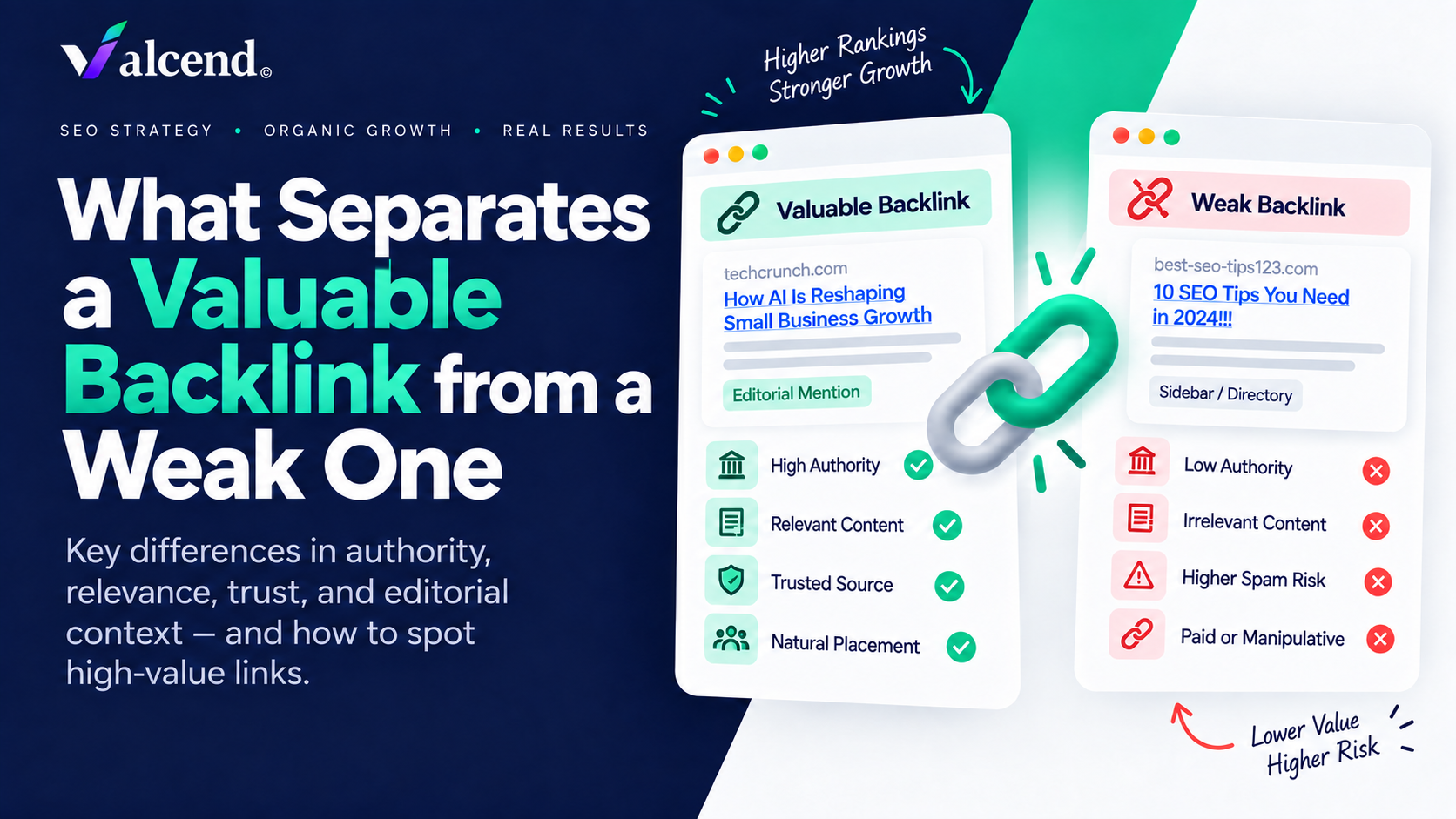
Weak is not the same as manipulative
This distinction matters because SEO reporting often uses terms such as weak, toxic, and spammy too loosely.
Different problems
Low impact and policy risk are not the same thing
- Limited topical relevance
- Little visibility or audience reach
- Poor match to the destination
- Not worth meaningful outreach effort
- Paid ranking credit
- Automated link creation
- Excessive exchanges
- Low-quality link networks or directories
- Distributed optimized links
A small legitimate website may give you a low-impact backlink. You usually do not need to fear it. You simply should not invest much effort in acquiring more links like it.
Manipulative links are different. Google's spam policies specifically identify buying or selling links for ranking purposes, excessive exchanges, automated links, low-quality directories, and distributed optimized links as examples of link spam. Google has also documented systems designed to neutralize unnatural link credit. Google's link-spam update documentation describes that behavior.
Measure links as inputs, not business outcomes
Backlinks are outputs of authority-building work. They are not the final business result.
Metric-to-decision map
Use each backlink metric for the question it can actually answer
| Metric | Role | Decision it supports |
|---|---|---|
| Backlinks earned | Output | Did external references increase? |
| Relevant referring domains | Diagnostic | Is recognition coming from appropriate sources? |
| Target-page impressions | Diagnostic | Is organic visibility changing? |
| Referral sessions | Diagnostic | Does the placement reach actual visitors? |
| Organic clicks | Diagnostic | Is search visibility producing visits? |
| Qualified leads | Business KPI | Are useful prospects reaching the business? |
| Opportunities / revenue | Business KPI | Is the broader SEO investment contributing commercially? |
Search Console's Links report can identify linking sites, target pages, and common anchor text, although Google explicitly says the report is a sample rather than a complete inventory of every link it knows about.
Third-party tools can provide broader backlink databases and their own metrics. Google Analytics can help evaluate referral traffic, while the CRM or sales system should determine whether visitors become meaningful prospects.
Do not credit one backlink as the sole cause of a ranking increase. Google's ranking systems use many signals, while competitors, content, internal links, search-result composition, and external conditions can change at the same time.
Evaluate the reason behind the link, not just the number beside it
Backlink quality cannot be reduced to Domain Rating. It also cannot be reduced to relevance, dofollow status, traffic, or anchor text individually.
A strong reference has a coherent reason to exist. It appears in a relevant context, comes from a credible source, sends the reader somewhere useful, and supports a page or business outcome worth strengthening.
That makes backlink evaluation less convenient than sorting a spreadsheet from highest DR to lowest. It also makes the decision much more useful.