Good outreach cannot fix a weak reason to link
The difficult part of link building is rarely finding email addresses. It is giving another publisher a credible reason to reference your page.
Google still uses links to understand relationships between pages, and its current ranking-systems documentation says PageRank remains part of Google's core systems. But Google's spam policies also draw a clear line between legitimate editorial references and links created primarily to manipulate rankings.
That includes buying links that pass ranking credit, automated link creation, excessive exchanges, and low-value distributed content designed mainly to manufacture links.
The useful question is not “Where can we get a backlink?” It is “What can we provide that makes a relevant publisher's page better, more complete, or easier to verify?”
Publisher-first reasoning
Why would someone link?
The reason should create value for the publisher's audience before it creates value for your SEO report.
- Improve our rankings
- Increase our DR
- Meet this month's link quota
- Place exact-match anchor text
- Verify a fact or source
- Access original data or a useful resource
- Credit existing expertise or recognition
- Give readers stronger context
The Valcend Reference-Earning Method
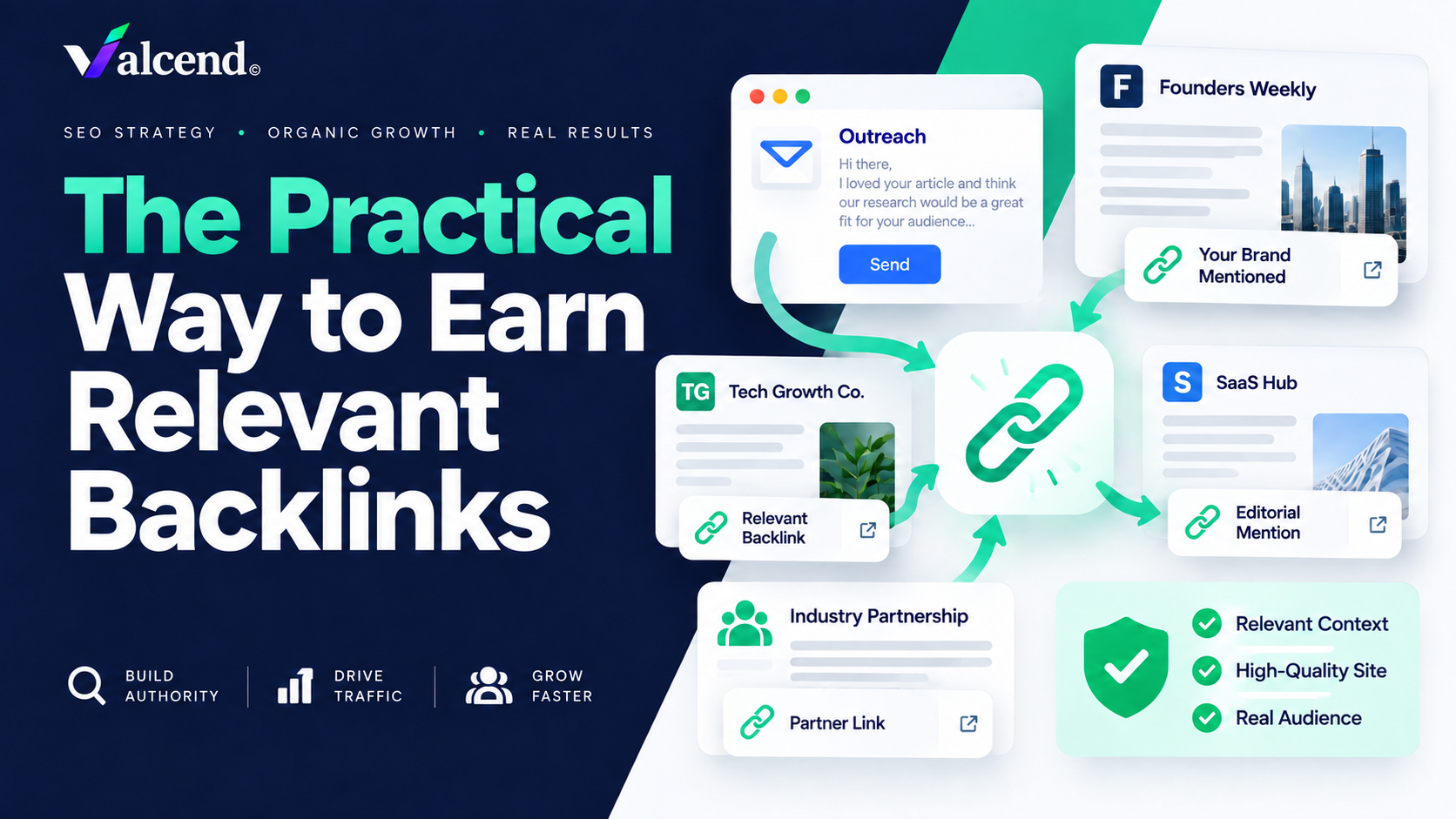
For a small or mid-sized business, three routes provide a practical starting point: create something worth citing, recover attribution you have already earned, or contribute expertise that improves someone else's content.
Original Valcend framework
Three routes to a relevant backlink
Each route begins with a different source of editorial value and converges on a legitimate external reference.
Create data, tools, references, or resources that another page genuinely needs.
Find genuine mentions or uses of your work where attribution would help the reader.
Contribute original insight where it improves a relevant publication or resource.
Consider Accounting Experts, a mid-sized accounting firm in Austin, Texas. Fictitious business used for illustrative purposes. Its objective is to strengthen useful search visibility around small-business accounting services.
Before outreach begins, the firm identifies a page worth supporting and asks a harder question: why would another legitimate website ever need to reference us?
1. Create a resource worth citing
Turn knowledge, data, or utility your business can provide into something publishers can legitimately reference.
This route works best when your business can produce information people already need to cite. Useful formats include original research, current statistics, calculators, templates, benchmark reports, regulatory calendars, detailed reference guides, and original datasets.
For Accounting Experts, a plausible asset might be a Texas Small-Business Accounting and Tax Deadline Calendar. The underlying dates would come from primary government sources. The value created by the business would be the organization, explanation, maintenance, and small-business context.
Then find pages already discussing Texas business resources, tax deadlines, startup compliance, entrepreneurship, or accounting calendars. Backlink-analysis tools can also reveal who references older or weaker resources covering the same need.
Reference-asset workflow
Build the linking reason before the outreach
Ahrefs published a historical case study in 2020 where it built a statistics resource around facts publishers were already citing and contacted pages linking to older sources. The campaign earned 36 editorial links from 32 websites after 515 outreach emails. That example demonstrates the mechanism, not a 2026 conversion-rate expectation.
Do not pitch the asset as “our latest blog post.” Explain which part of the publisher's page it could improve and why the source is more useful or current.
Build a reference asset when people already need to cite information that your business can provide unusually well.
Relevant referring pages citing the resource.
Greater discovery, referral exposure, and support for commercially important pages through sensible internal linking.
2. Reclaim recognition you already earned
Turn genuine existing recognition into accurate attribution where a link helps the reader verify or explore the source.
Sometimes the hardest part has already happened. Another organization may already mention your brand, an employee, original research, a photograph, a product, an event, or a quotation without linking to the source.
For Accounting Experts, imagine a local entrepreneurship organization writes that the firm's team recommends reviewing cash flow before committing to a major equipment purchase. The firm has already earned the editorial mention. A reasonable request is simply whether linking the attribution to the original source would help readers verify or explore the guidance.
Search for exact brand names, expert names, proprietary study titles, distinctive phrases from your research, and images or charts you created. Brand-monitoring and backlink-analysis tools can make this faster, but manual search is often sufficient for a smaller company.
Do not request a link from every mention automatically. Sometimes a publisher intentionally does not link, and sometimes adding one would not improve the page. Editorial fit still comes first.
Request attribution when the reference already exists and the link would make the underlying source easier for readers to verify or explore.
Relevant unlinked mentions converted into attributable references.
Stronger attribution, referral opportunity, and external recognition without manufacturing a new relationship.
3. Contribute expertise where it improves the publication
Use credible specialist knowledge to improve relevant editorial content instead of treating guest contributions as link-delivery vehicles.
For an accounting firm, useful contributions might address when a small business should outsource bookkeeping, common cash-flow reporting mistakes, accounting considerations when hiring a first employee, or financial information lenders commonly request.
Potential destinations include relevant business publications, trade associations, entrepreneurship resources, and local business organizations. A useful contribution pitch contains the specific topic, why your experience is relevant, one concise original observation, evidence or explanation supporting it, and an offer to provide additional detail.
If the publication decides that a link to your profile, research, biography, or supporting resource helps its audience, the reference emerges naturally from the contribution.
Guest contributions are not inherently spam. The risk begins when paid or scaled articles are created primarily to manufacture ranking links. Google's spam policies specifically identify optimized links in paid or distributed articles as a potential form of link spam.
For commercial sponsorships, Google recommends qualifying links using rel="sponsored" or nofollow as appropriate.
Contribute when your expertise improves the publisher's information even if the backlink were removed from the equation.
Relevant editorial contributions, quotations, citations, and references.
External authority, referral exposure, brand discovery, and potential support for organic visibility.
How to decide which tactic to use
Start with the advantage the business already has. You can eventually use all three routes, but you do not need all three at once.
Tactic selection
Use the asset you already possess
Best when your organization can produce information that publishers already need to reference.
Best when the editorial relationship already exists but attribution is incomplete.
Best when expertise itself can improve relevant third-party content.
Before launching outreach, write one sentence answering: “Why is linking to this useful for their reader?” If the answer is mostly about helping your SEO, the opportunity is probably weak.
Measure more than backlink count
A campaign can acquire links and still produce little business value. Separate outreach activity from the downstream evidence that tells you whether the work is helping.
Measurement chain
A link is an output, not the final outcome
| Metric | Role | Decision it supports |
|---|---|---|
| Prospects reviewed | Activity | Is enough relevant research happening? |
| Outreach sent | Activity | Was promotion executed? |
| Links earned | Output | Did publishers reference the asset? |
| Relevant referring domains | Diagnostic | Is credible recognition expanding? |
| Referral traffic | Diagnostic | Does the placement reach actual readers? |
| Target-page impressions and clicks | Diagnostic | Is organic visibility changing? |
| Qualified leads and opportunities | Business KPI | Is the wider SEO investment reaching useful demand? |
Google Search Console's Links report can show top linked pages and linking sites, although Google says it is a sample rather than a comprehensive list of every backlink it knows about.
Do not treat a ranking increase after one new link as proof of causation. Google's ranking systems use many signals, competitors change, pages are updated, and search results move for multiple reasons. Google's SEO Starter Guide also cautions that changes can take anywhere from hours to several months to show effects.
Earn the reason before asking for the link
The strongest link-building opportunities become easier to recognize when backlinks stop being treated as placements.
Create information another publisher needs. Recover attribution for recognition you have already earned. Contribute expertise that improves somebody else's work.
All three routes start from the same principle: the link should make sense for the publisher and its audience before it makes sense for your SEO report.
That does not make link building effortless. Outreach still requires research, persistence, judgment, and a page worth supporting. It does make the work more defensible and more closely connected to why external references matter in the first place.
Need help deciding which authority-building opportunities deserve effort?
At Valcend, I evaluate link opportunities alongside search intent, page quality, competitive difficulty, authority gaps, and business value. The objective is not to manufacture a backlink quota. It is to identify where relevant external recognition can strengthen the pages and search opportunities that matter commercially.
Book a consultation
Emilio Tinoco
Emilio Tinoco is the Founder and Digital Marketing Strategist at Valcend. He has more than eight years of experience across SEO, paid media, lead generation, analytics, measurement, and business-to-consumer marketing. His approach starts with business objectives and customer demand before determining which content, technical improvements, acquisition channels, and authority-building activities deserve investment. Through Valcend, Emilio helps businesses connect search visibility to qualified customer opportunities and measurable growth.
More about EmilioMethodology and sources
This article was researched on September 6, 2026. Research prioritized current Google Search Central documentation concerning ranking systems, link behavior, spam policies, paid-link qualification, and Search Console reporting. Current Ahrefs, Semrush, and Search Engine Land material was reviewed to understand competing link-building guidance and contemporary implementation concerns.
Recent community discussions were used only to identify practitioner frustrations with outreach and paid placements, not as statistical or ranking evidence. Accounting Experts and all examples attributed to it are fictitious and illustrative. Google link policies and link-analysis guidance should be reviewed within six months for freshness.
References
- A Guide to Google Search Ranking Systems. Google Search Central. Updated 2025. Direct source. Accessed September 6, 2026.
- Spam Policies for Google Web Search. Google Search Central. Current September 2026 documentation. Direct source. Accessed September 6, 2026.
- Qualify Outbound Links to Google. Google Search Central. Current documentation. Direct source. Accessed September 6, 2026.
- SEO Link Best Practices for Google. Google Search Central. Updated December 10, 2025. Direct source. Accessed September 6, 2026.
- Links Report. Google Search Console Help. Current documentation. Direct source. Accessed September 6, 2026.
- SEO Starter Guide. Google Search Central. Current documentation. Direct source. Accessed September 6, 2026.
- Link Building for SEO: The Beginner's Guide. Tim Soulo, Ahrefs. Current guide. Direct source. Accessed September 6, 2026.
- Link Building Case Study: How We Built Backlinks With a Stats Page. Joshua Hardwick, Ahrefs. August 18, 2020. Historical implementation example. Direct source. Accessed September 6, 2026.
- How to Get Backlinks in 2026: 10 Tactics That Actually Work. Semrush. April 22, 2026. Direct source. Accessed September 6, 2026.
- Link intent: How to combine great content with strategic outreach. Search Engine Land. June 1, 2026. Direct source. Accessed September 6, 2026.