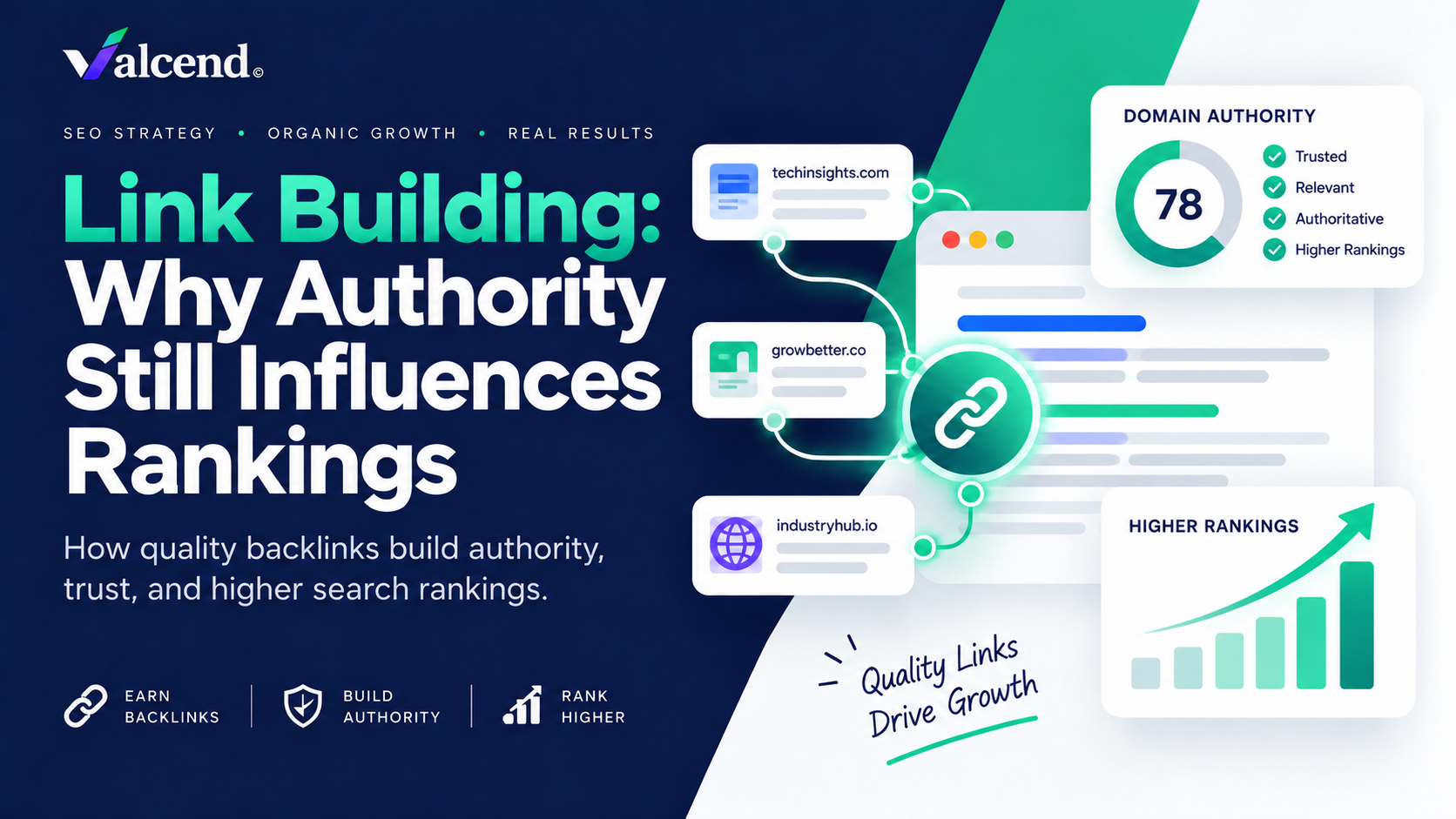
Links still matter. The explanation needs updating.
Google still uses link analysis in its core ranking systems. That does not mean every backlink is valuable, or that a third-party authority score is Google's ranking score.
Google's current ranking-systems documentation says it uses multiple systems to understand how pages link to one another and which pages may be useful. PageRank has changed substantially since Google's early years, but Google explicitly says it remains part of its core ranking systems.
What Google does not say is that websites rank according to Domain Authority, Domain Rating, or another third-party SEO score. Ahrefs describes Domain Rating as its own proprietary metric and notes that Google does not use DR as a ranking factor.
That distinction matters commercially. A business can increase an SEO tool's authority score while earning links that do little for its most important pages, attract no relevant audience, and support no meaningful business outcome.
The modern link-building question is not “How many backlinks do we need?” It is “Which pages need more external authority, and what would make credible sources genuinely want to reference them?”
Why the old link-building model is insufficient
| Dimension | Conventional approach | Limitation | Recommended approach | Business effect |
|---|---|---|---|---|
| Goal | Increase backlink count | Quantity can lack relevance | Strengthen priority pages | Better resource allocation |
| Prospecting | Filter by high DR/DA | Third-party score is not Google authority | Evaluate relevance and editorial quality | Better references |
| Content | Find somewhere to insert a link | Creates transactional placements | Create something worth citing | More defensible authority |
| Reporting | Links acquired this month | Measures production | Measure target-page performance | Stronger accountability |
| Paid placements | Buy followed links | Can violate Google's policies | Qualify sponsorship correctly | Lower policy risk |
Google's spam policies specifically identify buying or selling links for ranking purposes, automated link creation, excessive exchanges, and low-quality directory or distributed links as link spam.
Paid sponsorship itself is not prohibited. Google instructs publishers to qualify paid placements with rel="sponsored" or, where appropriate, nofollow. If a placement only makes commercial sense when it passes ranking credit, reconsider why you are buying it.
1. Find where authority is actually the constraint
Avoid spending on outreach when the page's bigger problem is intent, content, technical accessibility, or the offer itself.
Start with the target page. Does it satisfy the right search intent? Is the information genuinely competitive? Can Google crawl and index it? Is it internally linked properly? Is the site already earning impressions? Do competing pages appear to have materially stronger external references?
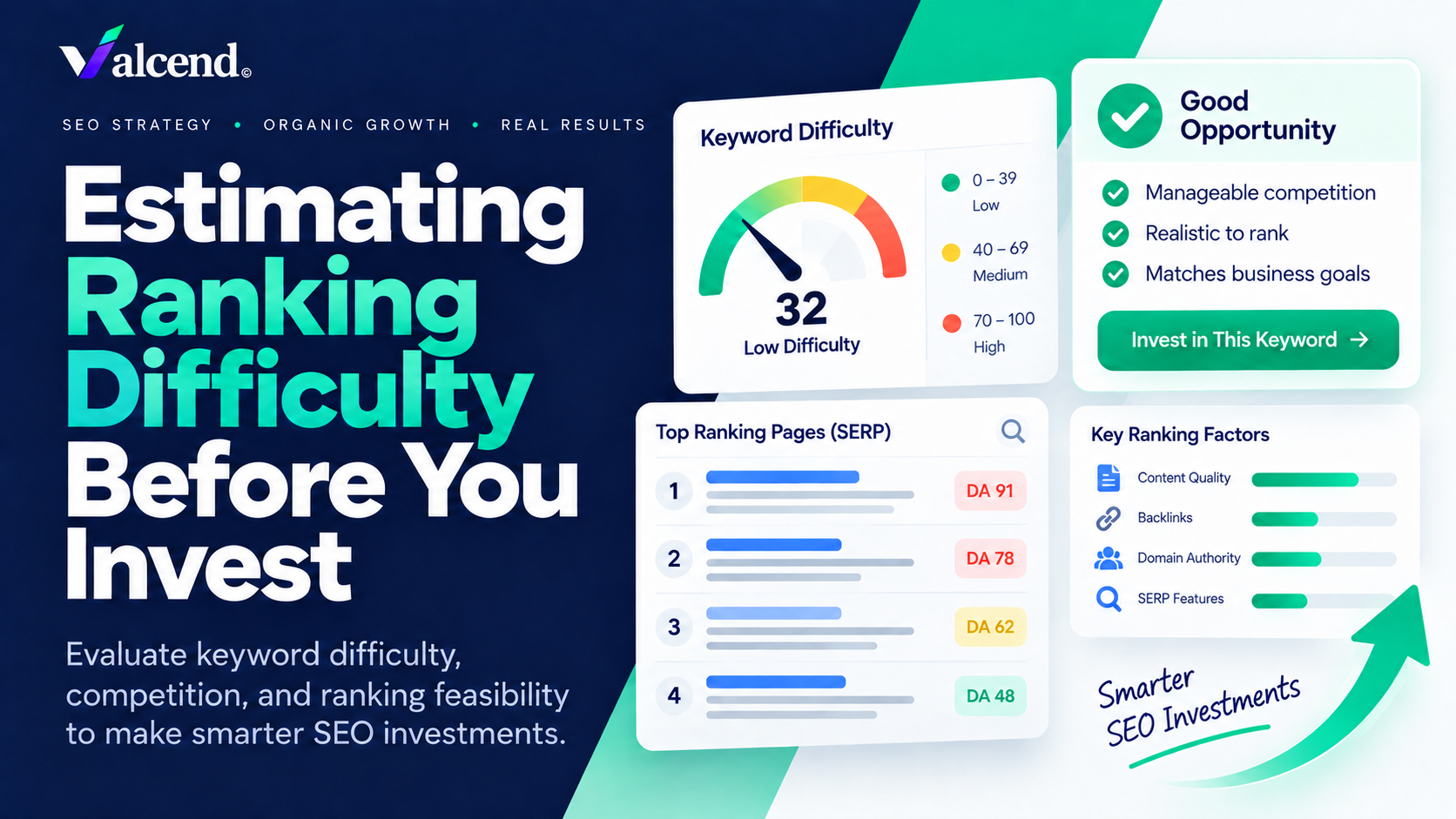
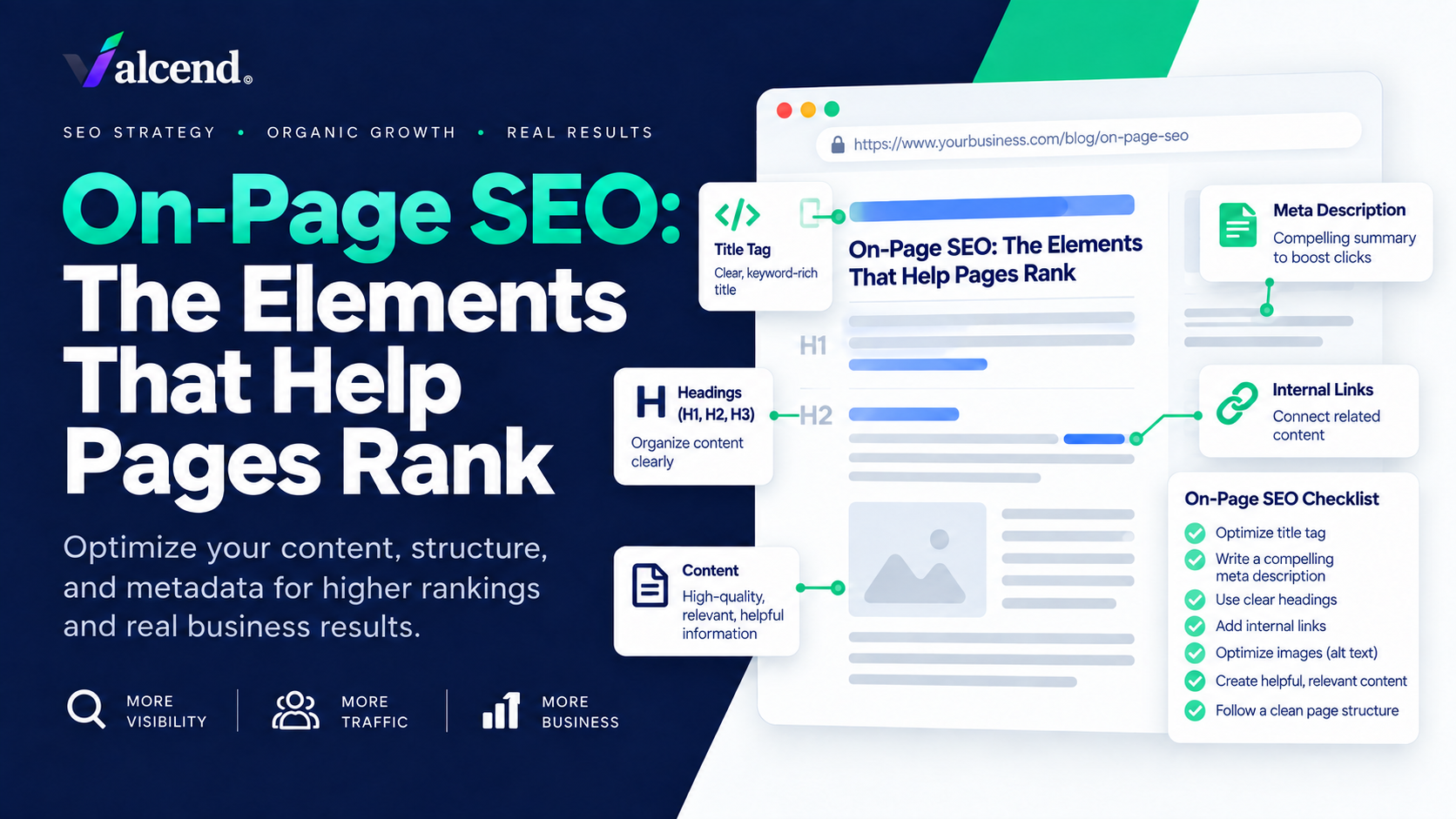
If the page serves the wrong search job, backlinks solve the wrong problem. If it is thin or poorly structured, strengthen it first. Valcend's guides to estimating ranking difficulty and on-page SEO cover those earlier constraints.
Use link building when external authority appears to be part of the competitive gap, not because every SEO campaign is supposed to contain a monthly link quota.
A documented authority gap for a specific target page.
Resources move toward pages with a credible path to qualified search visibility.
2. Decide which page deserves external support
Concentrate authority work around URLs whose improved visibility could matter commercially.
A common mistake is building most links to the homepage because it is easy to pitch the company. Ranking opportunities usually exist at the page level.
For Accounting Experts, the priority could be the core accounting-service page, an authoritative supporting guide, or a useful original resource that internally links to the service page. Google says its ranking systems primarily operate at the page level, although site-wide signals also contribute to its understanding.
Prioritize URLs where a meaningful improvement in visibility could influence relevant search demand, not simply pages that are easiest to promote.
A small set of priority URLs with defined search opportunities.
External authority is directed toward commercially useful visibility.
3. Create a legitimate reason to cite it
Make outreach useful to the publisher instead of asking for a link simply because the business wants one.
For the fictitious accounting firm, a generic service page may have limited editorial appeal. A more useful supporting asset could be an annually maintained Texas small-business accounting and tax deadline reference based on primary government sources.
Other cite-worthy assets can include original research, proprietary data, calculators, templates, reference guides, expert analysis, or unusually clear explanations.
Build something that improves the linking publisher's page, not merely something you want them to promote.
A resource with an identifiable editorial reason to be referenced.
A stronger probability of earning legitimate references and relevant referral exposure.
4. Earn relevant editorial references
Evaluate prospects on relevance and editorial legitimacy rather than letting one authority metric make the decision.
A useful prospect should make sense even if SEO metrics did not exist. Evaluate topical relevance, editorial legitimacy, audience value, placement context, and the quality of the referring page itself.
Prospect evaluation
A link-quality decision map
Use third-party metrics to triage. Use contextual judgment to decide.
Ahrefs' own Domain Rating documentation is useful for understanding what DR measures. Use it as one research input, not a proxy for editorial quality.
Rejecting a highly relevant publisher because its DR is lower than an arbitrary threshold, or accepting an irrelevant placement simply because the score is high.
Relevant referring domains and editorial placements that pass a documented quality screen.
More defensible authority, referral exposure, and support for priority pages.
5. Measure contribution instead of counting links
Separate campaign production from evidence that the wider SEO investment is becoming more useful.
A backlink acquired is an output. What happens afterward is more important.
Outputs versus outcomes
From earned link to business evidence
The chain is diagnostic, not proof that one backlink caused one ranking or sale.
Google's Search Console Links report can show top linked pages, linking sites, and anchor text, although Google notes that the report is a sample rather than a comprehensive list of every backlink. Its Performance report can then show impressions and clicks associated with organic visibility.
Do not attribute every ranking increase to the most recently acquired backlink. Google uses many systems and signals, competitors change, pages are updated, and rankings move for multiple reasons. Evaluate the trend over multiple weeks and months rather than treating short-term movement as causal proof.
What about AI search?
AI search is a legitimate reason to think more broadly about authority, but it should not be used to invent unsupported backlink rules.
Google says its generative AI features rely on its core ranking and quality systems and that existing SEO best practices remain relevant. AI Overviews and AI Mode can also link people to source material. Google's generative-AI optimization guidance does not publish a DR threshold, backlink quota, or special authority score for AI citations.
Build information and external recognition that would make the business credible regardless of whether discovery occurs through a traditional result, an AI-generated search experience, a publisher, or a referral.
What good link building should ultimately accomplish
Links still matter because relationships between pages remain part of how Google's systems understand usefulness and importance.
What has changed is the standard we should use to evaluate the work. A good link is not good because a spreadsheet says the referring domain has DR 80. It is good when the reference is relevant, legitimate, useful in context, and supports a page that deserves visibility.
That reframes link building from “How many backlinks can we acquire?” to “What external recognition would strengthen the pages that matter to the business?”
That is a harder question. It is also a better SEO strategy.
Need help identifying where authority is limiting organic growth?
At Valcend, I evaluate search intent, content, competitive difficulty, internal structure, external authority, and business potential together. The objective is not to sell a monthly backlink quota. It is to determine whether external authority is actually constraining valuable search visibility and what kind of work can close that gap.
Book a consultation
Emilio Tinoco
Emilio Tinoco is the Founder and Digital Marketing Strategist at Valcend. He has more than eight years of experience across SEO, paid media, lead generation, analytics, measurement, and business-to-consumer marketing. His approach starts with business objectives and customer demand before determining which content, technical improvements, paid acquisition, and authority-building activities deserve priority. Through Valcend, Emilio helps businesses connect search visibility to qualified opportunities and measurable growth.
More about EmilioMethodology and sources
This article was researched on September 6, 2026. Research prioritized current Google Search Central documentation covering ranking systems, PageRank, link spam, link qualification, Search Console link reporting, and generative-AI search. Current link-building guides from Ahrefs, Semrush, Backlinko, and Search Engine Land were reviewed to understand the competitive landscape.
Accounting Experts is fictitious and used only for illustration. Practitioner discussions were used only to identify common concerns, not as ranking evidence. The sections covering Google link policies, Search Console reporting, AI search, and third-party authority metrics should be reviewed within six months.
References
- A Guide to Google Search Ranking Systems. Google Search Central. Updated December 10, 2025. Direct source. Accessed September 6, 2026.
- Spam Policies for Google Web Search. Google Search Central. Current September 2026 documentation. Direct source. Accessed September 6, 2026.
- Qualify Outbound Links to Google. Google Search Central. Current documentation. Direct source. Accessed September 6, 2026.
- SEO Link Best Practices for Google. Google Search Central. Updated December 10, 2025. Direct source. Accessed September 6, 2026.
- Links Report. Google Search Console Help. Current documentation. Direct source. Accessed September 6, 2026.
- Performance Report: Search Results. Google Search Console Help. Current documentation. Direct source. Accessed September 6, 2026.
- Optimizing Your Website for Google's Generative AI Features. Google Search Central. Updated 2026. Direct source. Accessed September 6, 2026.
- What Is Domain Rating? Ahrefs Help Center. Updated 2026. Direct source. Accessed September 6, 2026.
- Do Search Engines Use Domain Authority / Domain Rating as a Ranking Factor? Ahrefs Help Center. Updated 2026. Direct source. Accessed September 6, 2026.
- Link Building for SEO: The Beginner's Guide. Tim Soulo, Ahrefs. Current guide. Direct source. Accessed September 6, 2026.
- Link Building for SEO: What Works in 2026. Chris Hanna, Semrush. July 17, 2026. Direct source. Accessed September 6, 2026.
- Link Building in 2026: 5 Proven Ways to Boost Authority. Backlinko. June 11, 2026. Direct source. Accessed September 6, 2026.