
Good keyword research starts before the keyword tool
One of the easiest ways to build the wrong SEO strategy is to begin with terminology your company uses internally.
A business might describe a service as fractional financial reporting support. Its customers may simply ask for an outsourced accountant. Both phrases can describe a related need, but only search evidence can tell you how that need appears in organic search.
The distinction matters more as search becomes conversational. Alphabet reported in February 2026 that queries in Google's AI Mode were about three times longer than traditional Search queries and often continued with follow-up questions. That is Google-reported product behavior, not a measure of all search activity, but it reinforces the value of researching customer problems rather than building strategy only around short seed terms. Alphabet's Q4 2025 CEO remarks provide the original context.
Google Search Console has encountered the same language problem from another direction. Its Query groups feature can group different phrasings that express a similar need, including variations and misspellings. Google's Query groups announcement explains why grouping by intent can make query data easier to interpret.
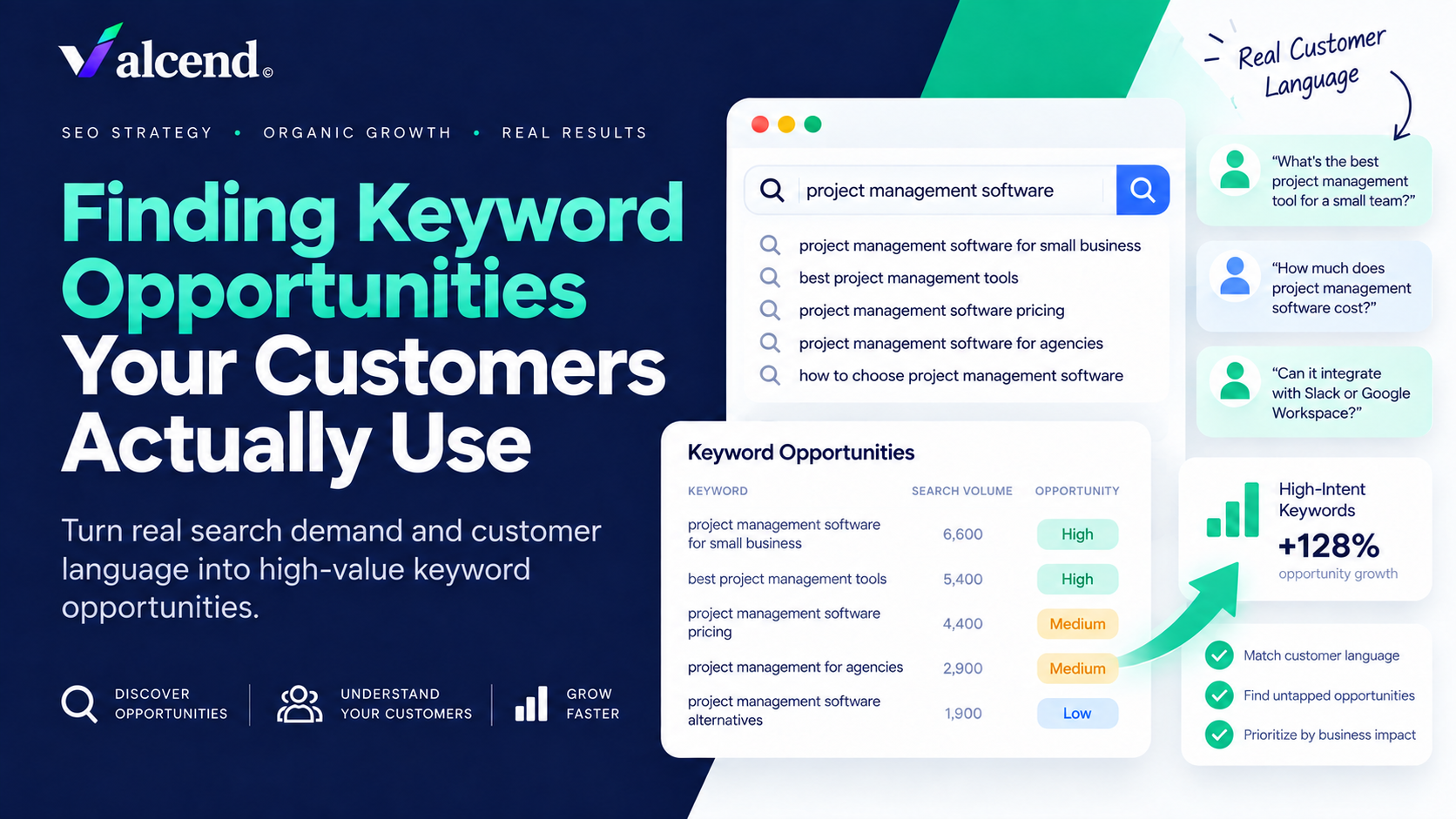
Customer language generates hypotheses. Search data validates demand. Business value determines priority.
Customer language is evidence, not proof of search demand
Keep three things separate. Customer language tells you how people describe a problem. Search data tells you whether and how that problem appears in search behavior. Business value tells you whether earning visibility for that demand is worth the investment.
| Dimension | Tool-first approach | Language-first approach | Business effect |
|---|---|---|---|
| Starting point | Industry seed keyword | Customer problem or question | Better vocabulary |
| Expansion | Keyword database | Customer evidence plus tools | More relevant ideas |
| Validation | Volume and difficulty | Demand, intent, SERP and business fit | Fewer wasted targets |
| Success | More keywords | More qualified opportunities | Stronger commercial alignment |
The Valcend Language-to-Demand Method
The process is deliberately short. Listen first, validate second, then prioritize only the opportunities that can connect search behavior to a useful business outcome.
Original Valcend framework
From customer language to validated opportunity
Each stage removes a different kind of uncertainty before content or technical resources are committed.
Consider Accounting Experts, a mid-sized accounting firm in Austin, Texas. Fictitious business used for illustrative purposes. The firm offers bookkeeping, tax planning, payroll support, and outsourced accounting.
1. Capture customer language
Start where customers speak naturally: discovery calls, contact forms, support emails, reviews, onsite search, CRM notes, sales-call transcripts, and relevant professional communities.
Ahrefs' current keyword-research guide also recommends studying customer conversations, forums, groups, and question-and-answer communities. The useful point is not that community language equals keyword volume. It gives you problems and vocabulary worth testing.
Suppose an Accounting Experts prospect asks: "Can someone handle our books every month without us hiring another accountant?"
That sentence reveals concepts such as monthly bookkeeping, outsourced accounting, recurring support, and an alternative to internal hiring.
Common mistake: Turning every customer phrase directly into a page title. Conversation language is valuable evidence, but people may compress the same need into a much shorter search.
2. Turn language into search hypotheses
Translate recurring problems into several plausible ways someone might search. Do not decide yet which phrase deserves a page.
Illustrative example
One customer sentence can produce several search hypotheses
"Handle our books every month without hiring another accountant."
Google Trends can surface related and rising searches, while Google's related-search features can expose alternate ways people explore the same subject. Use those suggestions to expand the hypothesis set, not as proof that every variation deserves a separate page.
3. Verify actual search demand
Now bring in search data. Google Keyword Planner can generate keyword ideas from words or websites and provide historical search estimates. Google Trends answers a different question: it uses a sampled, anonymized, categorized, and aggregated set of Google searches, then normalizes interest by time and geography. It is useful for relative interest, wording comparisons, seasonality, and geographic patterns rather than absolute monthly volume. Google's Keyword Planner documentation and Google Trends' data methodology explain those differences.
Evidence stack
Use different sources to answer different questions
Third-party SEO tools such as Ahrefs, Semrush, or Moz can add useful estimates for ranking difficulty, related keywords, competitor performance, and SERP analysis. No single metric should make the decision.
4. Qualify the opportunity
Once demand exists, ask whether it is useful demand. I recommend four checks: does the intent fit, does the business fit, can the site compete, and is there a page worth creating or improving?
A thousand searches for a free bookkeeping spreadsheet may matter less to Accounting Experts than a smaller pool of companies searching for outsourced bookkeeping in Austin. Search relevance tells you whether the business belongs in the conversation. Business potential tells you whether winning that conversation is worth the investment.
For the intent check, use Valcend's guide to reading search intent before targeting a keyword. For the economic prioritization, see Choosing Keywords That Match Demand and Business Goals.
Prioritize a keyword when customer relevance, demonstrated search demand, intent, page fit, and business value reinforce one another.
5. Validate with performance data
Research produces a hypothesis. Performance determines whether it was useful.
For established sites, Google Search Console is especially valuable because its Performance reporting exposes queries generating impressions and clicks. Google also notes that some queries are anonymized and not every query is shown. Search Console's Performance documentation explains the available dimensions and limitations.
If the company runs Google Ads, the Search terms report adds another first-party source because it contains actual searches that triggered ads, subject to reporting thresholds. Google's Search terms report documentation explains the distinction between search terms and advertiser keywords.
For Accounting Experts, the useful measurement chain is: query → organic landing page → qualified inquiry → consultation → opportunity → customer.
Outputs versus business outcomes
Keyword research creates useful outputs, but a large keyword list is not the business result.
| Metric | Role | Decision it supports |
|---|---|---|
| Customer phrases collected | Research output | Whether customer vocabulary is understood |
| Keywords discovered | Research output | Breadth of opportunity |
| Search volume | Diagnostic | Whether measurable demand exists |
| Rankings and clicks | Diagnostic | Whether visibility and traffic capture are improving |
| Qualified leads | Business KPI | Whether the audience fits |
| Sales opportunities | Business KPI | Whether demand has commercial value |
| Revenue | Business KPI | Whether organic search contributes economically |
If rankings and sessions improve while qualified inquiries do not, investigate the intent, customer fit, landing-page experience, or keyword strategy itself. More activity does not automatically mean better SEO.
Find the language first, then prove the opportunity
The keyword tool is not the beginning of good keyword research. The customer is.
Listen for how people describe the problem. Translate those patterns into possible searches. Validate them against observable search behavior. Inspect intent and competition. Then decide whether earning that visibility can create a meaningful business result.
That sequence prevents a common mistake: optimizing around terminology that looks attractive in a spreadsheet but does not reflect how valuable customers actually search.
Search strategy built around business value
Need help deciding which search demand deserves investment?
At Valcend, I connect keyword research to search intent, competitive reality, customer value, and measurable business outcomes.
Book a consultation
Emilio Tinoco
Emilio Tinoco is the Founder and Digital Marketing Strategist at Valcend. He has more than eight years of experience across SEO, paid media, lead generation, analytics, measurement, and business-to-consumer marketing. His approach starts with business objectives and customer demand before determining which keywords, content, technical improvements, and acquisition opportunities deserve investment. Through Valcend, he helps businesses connect search visibility to qualified customer opportunities and measurable growth.
More about EmilioMethodology and sources
This article was researched and updated on September 6, 2026. Research prioritized official documentation from Google Search, Search Console, Google Ads, and Google Trends, followed by current keyword-research resources from established SEO publishers. Practitioner discussions were used only to understand implementation concerns, not as statistical evidence.
Accounting Experts is fictitious and used solely for illustration. Search product features and AI-search behavior should be reviewed within six months because these systems continue to change.
References
- Keyword Research: The Beginner's Guide. Ahrefs. Current guide. Direct source. Accessed September 6, 2026.
- Alphabet earnings, Q4 2025: CEO's remarks. Google/Alphabet. February 2026. Direct source. Accessed September 6, 2026.
- Introducing Query groups in Search Console Insights. Google Search Central. October 27, 2025. Direct source. Accessed September 6, 2026.
- Use Keyword Planner. Google Ads Help. Current documentation. Direct source. Accessed September 6, 2026.
- FAQ about Google Trends data. Google Trends Help. Current documentation. Direct source. Accessed September 6, 2026.
- Find related searches. Google Trends Help. Current documentation. Direct source. Accessed September 6, 2026.
- Performance report: Search results. Google Search Console Help. Current documentation. Direct source. Accessed September 6, 2026.
- About the search terms report. Google Ads Help. Current documentation. Direct source. Accessed September 6, 2026.