
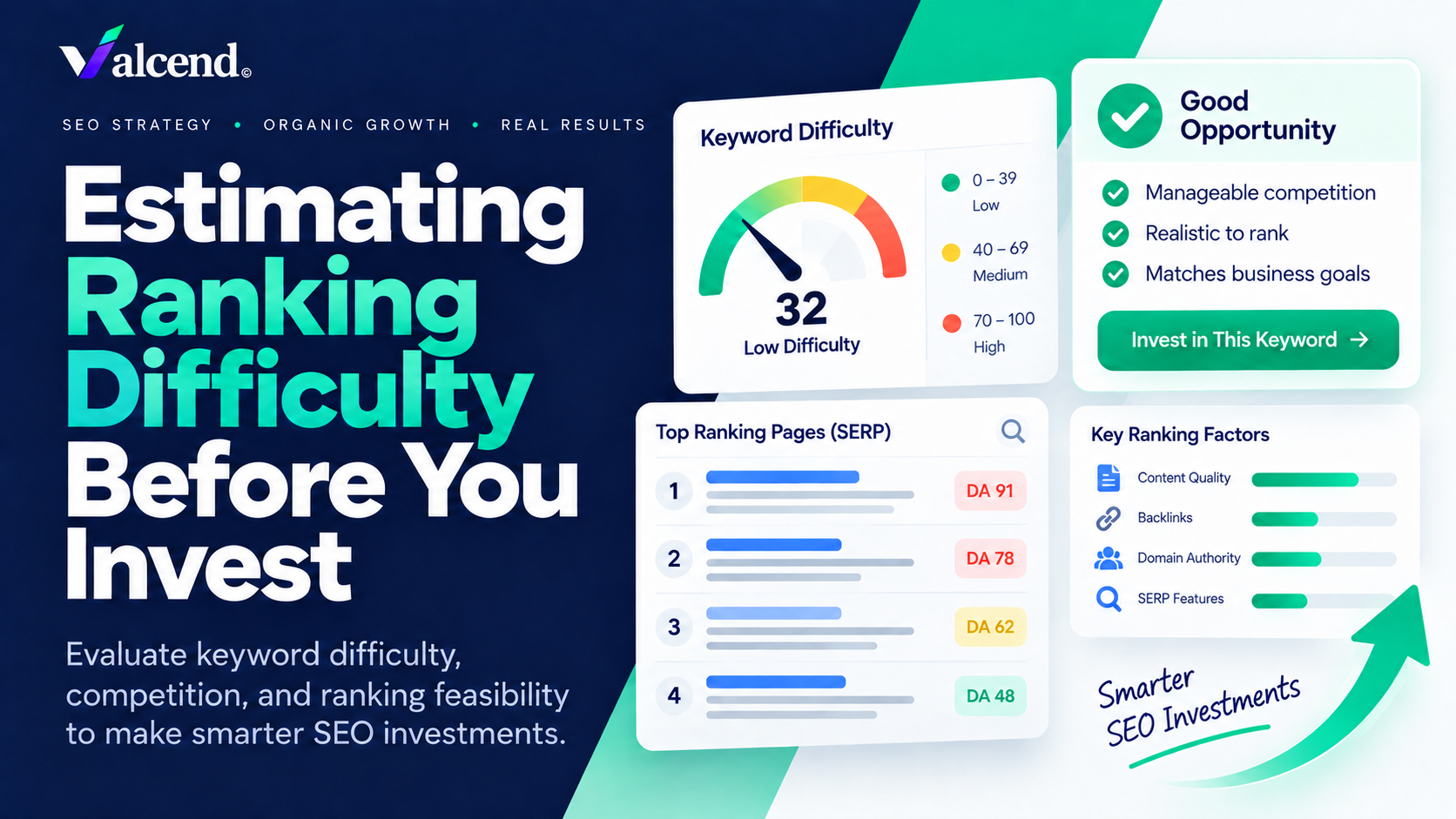
A difficulty score is useful, but it is not the decision
Keyword research tools make competition look remarkably precise. Enter a keyword and you may receive a score such as 27, 54, or 81.
The number is useful for screening opportunities, but it is not a ranking forecast.
Ahrefs bases Keyword Difficulty primarily on referring domains to pages already ranking in Google's top 10. Semrush uses a different methodology and also offers Personal Keyword Difficulty for a specific domain. Different methodologies can therefore produce different scores for the same query. Ahrefs explains its KD methodology, while Semrush documents its domain-specific metric.
Google does not publish a Keyword Difficulty score. Its ranking systems use multiple signals and systems, and Google cautions site owners against concentrating on only one or two factors when evaluating search performance. Google's ranking systems guide provides the primary documentation.
Why one score is incomplete
Keyword Difficulty summarizes the SERP. It does not model your entire ranking problem.
Use Keyword Difficulty to decide which SERPs deserve investigation. Do not use it alone to decide what deserves investment.
Why the same keyword is not equally difficult for every site
Imagine two businesses targeting the same search. One already has relevant pages, links, topical coverage, and a page ranking at position 14. The other has never published on the topic. Calling both situations "KD 55" hides a meaningful difference.
Semrush's Personal Keyword Difficulty reflects this problem directly by adjusting the estimate to the analyzed domain rather than applying only a market-wide difficulty number. That does not make the metric perfect, but the underlying principle is strategically useful: difficulty is relative to your starting position.
Same market, different starting point
Market difficulty and your ranking difficulty are not the same thing
Website A
- Relevant service page already exists
- Several supporting articles
- Relevant links and mentions
- Current visibility near page one
Website B
- No dedicated page
- Little topical coverage
- Few relevant referring domains
- No meaningful current visibility
SERP difficulty is how strong the existing competition appears. Your ranking difficulty is how large the gap is between those results and your current position.
The Valcend Ranking Investment Test
Keyword Difficulty becomes more useful when it sits inside a five-stage business decision.
Original Valcend framework
From difficulty score to investment decision
Each stage tests a different reason a keyword may or may not deserve resources.
Consider Accounting Experts, a mid-sized accounting firm in Austin, Texas. Fictitious business used for illustrative purposes. The firm is evaluating whether to target small business accountant Austin.
1. Confirm the search opportunity
Before analyzing difficulty, confirm that ranking would actually matter.
Check search demand, intent, geographic relevance, service fit, and likely customer value. If the query attracts businesses looking for an accountant in Austin and that service is strategically important, the opportunity passes the first test.
If you have not established that yet, start with Valcend's guides to finding keyword opportunities customers actually use and reading search intent before targeting a keyword.
Do not spend time estimating how difficult an irrelevant keyword is.
2. Benchmark the live SERP
Now inspect what Google actually ranks. A score summarizes the competition. The SERP shows what you would need to beat.
- Page type: Service pages, directories, articles, homepages, or local businesses?
- Relevance: How closely do winners satisfy the query?
- Page-level links: How strongly are ranking pages referenced?
- Site strength: National brands or comparable regional businesses?
- SERP composition: Do local, AI, directory, or other features change the click opportunity?
Google confirms that Search can display different result features according to the query and user context. Google's guide to how Search works explains this dynamic result selection.
Record the page type and competitive pattern, not just the domain names. A SERP dominated by strong domains can still contain relatively weak pages. The reverse can also be true.
3. Measure your competitive gap
Now compare your current page and domain with the winners.
| Signal | Ranking pages | Your page | What the gap suggests |
|---|---|---|---|
| Intent match | Strong service pages | Strong | Page type is viable |
| Local relevance | Austin-specific | Austin-specific | No major geographic gap |
| Service depth | Complete offer information | Thin | Page improvement needed |
| Relevant links | Several quality references | Few | Authority work needed |
| Internal support | Multiple related resources | Limited | Build supporting coverage |
| Existing visibility | Established | Position 35 | Meaningful distance remains |
All figures and positions in this Accounting Experts example are illustrative, not observed client data.
The goal is to identify the gaps that require real work and decide whether your business can realistically close them.
4. Estimate the required investment
Convert those gaps into work.
Accounting Experts might need a substantially stronger service page, better internal linking, supporting resources that answer customer questions, local authority signals, and relevant editorial mentions or links.
Google recommends creating helpful, reliable content with original information, analysis, or expertise rather than pages produced primarily to attract search traffic. Google's people-first content guidance provides the standard I would use when evaluating the content gap.
Treating links, word count, or authority scores as independent quotas. They are evidence about the competitive environment, not guaranteed ranking formulas.
A useful investment estimate is therefore expressed as time + content + development + promotion + authority work, not simply "KD 62."
5. Compare effort with business value
This is the step a difficulty tool cannot make for you.
Suppose small business accountant Austin requires substantial work but represents a core service with strong customer lifetime value. The investment may still make sense.
Now compare that with an easier query such as free accounting worksheet template. It might be simpler to rank for, but the resulting audience may have little commercial value.
Investment matrix
Difficulty matters only in relation to what winning is worth
Strong candidate for current investment.
Invest nowStrategically important, but may require authority and content development first.
Build toward itUseful only when it fills a clear supporting role.
OpportunisticWeak return relative to the resources required.
DeprioritizeConceptual framework. No ranking probability or revenue figure is implied.
I use three practical outcomes:
- Invest now: strong business value, realistic competitive gap, and appropriate resources.
- Build toward it: high strategic value, but the site first needs stronger content, authority, or topical support.
- Deprioritize: the expected benefit does not justify the effort.
This is where choosing keywords that match demand and business goals becomes more important than chasing the lowest KD number.
Measure progress without confusing rankings with results
Ranking difficulty is an estimate made before the investment. Performance data should determine whether that estimate was useful afterward.
| Metric | Role | Decision it supports |
|---|---|---|
| Content completed | Output | Was the planned work executed? |
| Relevant links earned | Output | Is the authority gap closing? |
| Impressions | Diagnostic | Is Google showing the page more often? |
| Average position | Diagnostic | Is search visibility trending in the right direction? |
| Organic clicks | Diagnostic | Is visibility producing visits? |
| Qualified leads | Business KPI | Is the traffic commercially useful? |
| Appointments | Business KPI | Are prospects progressing? |
| Revenue | Business KPI | Is the investment contributing financially? |
Google Search Console recommends looking closely at trends in clicks and impressions rather than relying on position alone. Google's Performance report guidance explains how those metrics should be interpreted.
Do not promise a fixed ranking timeline. Google says some changes can be reflected within hours while others can take several months, and not every improvement produces a noticeable ranking change. Google's SEO Starter Guide provides that timing caveat.
If visibility improves but qualified outcomes do not, reconsider intent, landing-page experience, or commercial value.
Difficulty is a cost question, not a stop sign
A high Keyword Difficulty score does not mean "do not target." A low score does not mean "invest."
The score tells you to investigate the competitive environment. The business decision comes from comparing that environment with your site's existing advantages, the work required to close the gap, and the value of winning.
That is the difference between finding an easy keyword and making a good SEO investment.
Search strategy built around business value
Need help deciding which rankings deserve investment?
At Valcend, I evaluate search demand, intent, competitive difficulty, technical requirements, content, authority, and business potential together. The goal is to identify which search opportunities justify the resources required to compete.
Book a consultation
Emilio Tinoco
Emilio Tinoco is the Founder and Digital Marketing Strategist at Valcend. He has more than eight years of experience across SEO, paid media, lead generation, analytics, measurement, and business-to-consumer marketing. His approach starts with business objectives and customer demand before determining which keywords, content, technical improvements, and acquisition opportunities deserve investment. Through Valcend, he helps businesses connect search visibility to qualified customer opportunities and measurable growth.
More about EmilioMethodology and sources
This article was researched and updated on September 6, 2026. Research prioritized Google Search documentation and current first-party documentation from major SEO platforms describing how their difficulty metrics are calculated. Current competitive guides were reviewed to identify common approaches and gaps. Practitioner discussions were used only to understand common confusion around difficulty metrics.
Accounting Experts and all competitive figures in its example are illustrative. Because third-party SEO tools change their methodologies, the sections describing Keyword Difficulty and Personal Keyword Difficulty should be reviewed within six months.
References
- A Guide to Google Search Ranking Systems. Google Search Central. Updated December 10, 2025. Direct source. Accessed September 6, 2026.
- Creating Helpful, Reliable, People-First Content. Google Search Central. Updated December 10, 2025. Direct source. Accessed September 6, 2026.
- In-Depth Guide to How Google Search Works. Google Search Central. Updated December 18, 2025. Direct source. Accessed September 6, 2026.
- SEO Starter Guide. Google Search Central. Updated 2025. Direct source. Accessed September 6, 2026.
- What does KD stand for in Keywords Explorer? Ahrefs Help Center. Updated 2026. Direct source. Accessed September 6, 2026.
- How is Personal Keyword Difficulty calculated? Semrush Knowledge Base. Current documentation. Direct source. Accessed September 6, 2026.
- Performance report: Common tasks and use cases. Google Search Console Help. Current documentation. Direct source. Accessed September 6, 2026.