
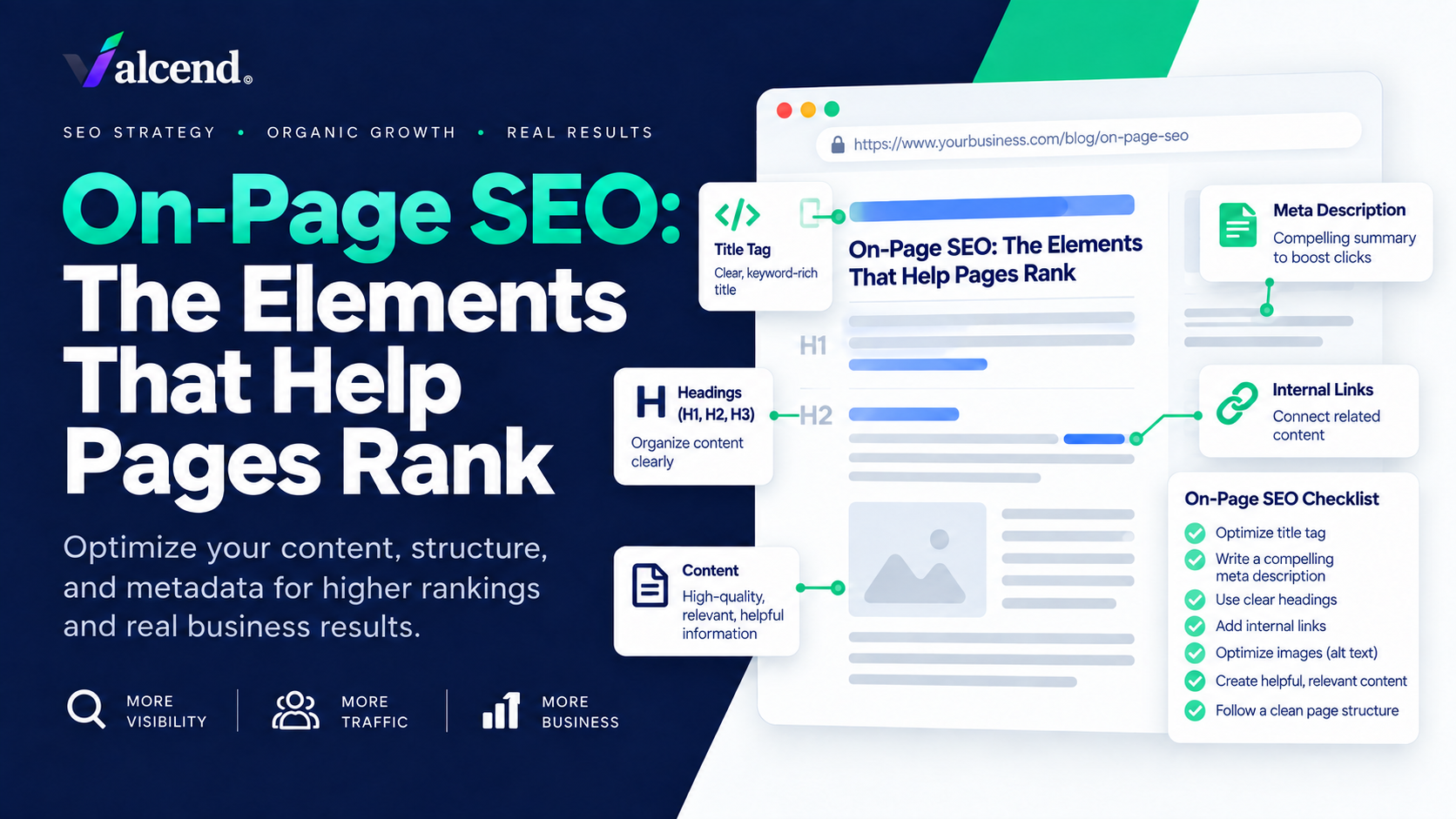
On-page SEO has become easier to overcomplicate
A typical on-page SEO checklist can contain dozens of instructions. Most can be useful. They do not all serve the same purpose.
Google's Search Essentials recommends using the words people search for in prominent places such as the page title, main heading, link text, and descriptive alt text. Google also emphasizes helpful, reliable content and crawlable links. Google Search Essentials is the clearest primary reference for those fundamentals.
At the same time, Google's documentation makes distinctions that generic checklists often blur. Meta descriptions can influence snippets rather than acting as a simple ranking control. Structured data can enable eligibility for richer search appearances but is not a generic ranking factor. Core Web Vitals contribute to page experience, but perfect scores do not guarantee top rankings. Google's snippet guidance, structured-data policies, and page-experience guidance document those distinctions.
The useful question is therefore not, "Have we optimized every SEO field?"
It is: Does this page clearly satisfy the right search, communicate what it offers, provide useful evidence, connect logically to the rest of the site, and move the right visitor toward a meaningful action?
Different elements, different jobs
Not every on-page element affects search in the same way
- Title and H1
- Page copy
- Descriptive headings
- Internal anchor text
- Title link
- Search snippet
- Meta description as a possible snippet source
- Accurate structured data
- Eligible rich-result features
- Visible content consistency
- Core Web Vitals
- Mobile usability
- Clear navigation
- Accessible media
Checklist SEO versus page alignment
| Dimension | Checklist approach | Limitation | Page-alignment approach | Expected effect |
|---|---|---|---|---|
| Keyword use | Place phrase in required locations | Can become mechanical | Make topic and intent unmistakable | Clearer relevance |
| Content | Reach a target word count | Length does not establish usefulness | Answer the searcher's actual decision | Greater usefulness |
| Metadata | Fill every field | Fields serve different functions | Optimize each for its real role | Better search presentation |
| Internal links | Add several links | Quantity lacks context | Link where relationships are useful | Better discovery and navigation |
| Schema | Add markup everywhere | Not a generic ranking factor | Use supported markup when eligible | Rich-result opportunities |
| Speed | Chase perfect scores | Relevance can matter more | Improve real page experience | Better usability and supporting signals |
Google explicitly says it does not have a preferred word count, and its current generative-AI guidance similarly rejects the idea that pages need an ideal length or artificial content chunking to perform. Google's people-first content guidance and 2026 generative-AI optimization guidance both support focusing on usefulness rather than arbitrary formatting targets.
The Valcend Page Alignment System
I recommend treating on-page SEO as six connected stages rather than a collection of independent fields.
Original Valcend framework
Align the search job with the page, then measure what happens
Consider Accounting Experts, a mid-sized accounting firm in Austin, Texas. Fictitious business used for illustrative purposes.
The firm wants to improve a service page intended for small-business owners looking for accounting support in Austin.
1. Match the page to the search job
Optimization begins before the title tag.
Search the target query and inspect what Google currently returns. Does the result page favor local firms, service pages, informational guides, directories, comparison pages, tools, or videos?
If small business accountant Austin behaves primarily like a local commercial search, publishing a long article explaining what accountants do would solve the wrong problem. The correct page may need service details, geographic relevance, credentials, proof, process, FAQs, and a clear consultation path.
For the deeper process, see Valcend's guide to reading search intent before targeting a keyword.
Fix intent mismatch before optimizing individual elements. A page that serves the wrong job has a larger problem than an imperfect title.
A confirmed page type and primary search job.
Qualified visitors arrive on an experience that matches what they were trying to accomplish.
2. Make the page purpose unmistakable
Once the page type is right, communicate its purpose clearly. Google recommends using terminology people would use to find the content in prominent locations such as the title and main heading. Search Essentials documents this directly.
For Accounting Experts, the page might use:
Title element: Small Business Accounting Services in Austin | Accounting Experts
H1: Accounting Services for Austin Small Businesses
These do not need to be identical. Google can use the <title>, visible page title, headings, anchor text, og:title, and other prominent content when generating title links. Google's title-link documentation explains those sources.
The opening copy should confirm the promise quickly. This is more useful than forcing one exact keyword into every possible field.
Illustrative service-page anatomy
Make the page's job visible before the visitor has to hunt for it
Repeating the exact target keyword unnaturally because an optimization tool reports low keyword frequency. Clarity and meaning matter more than mechanical repetition.
3. Build useful information around the decision
Once relevance is clear, the page needs to earn the visitor's attention.
Google's people-first content guidance asks whether content provides original information or analysis, demonstrates expertise, supports trust, and leaves the reader feeling they learned enough to achieve their goal. The official guidance is more useful than aiming for a predetermined word count.
For the accounting service page, useful information could include who the service is for, what is included, what problems it solves, how onboarding works, what the client needs to provide, how the service differs from hiring internally, geographic limitations, pricing variables, relevant experience, and realistic next steps.
The objective is not to make the page longer. It is to reduce uncertainty for the person making the decision.
Descriptive subheadings help visitors navigate and give search systems additional context about the structure of the information. Use headings to organize real questions rather than as containers for keyword variations.
A page that closes obvious information gaps without padding.
Visitors can evaluate the service with fewer reasons to return to search for missing answers.
4. Connect the page to the rest of the site
Pages do not operate independently.
Google recommends making important pages discoverable through crawlable links and using concise, relevant anchor text. Google's link best practices explain how links help both discovery and context.
Accounting Experts might link its service page to bookkeeping services, tax-planning guidance, an outsourced-versus-in-house comparison, client examples, and its consultation process. Relevant supporting articles should also link back to the commercial service page where that transition genuinely helps the reader.
For Valcend, the same logic applies when this page connects naturally to finding keyword opportunities or choosing business-relevant keywords.
Add a link because it helps someone continue the journey or clarifies a relationship, not because the page needs an arbitrary number of internal links.
5. Improve search appearance and page experience
Meta descriptions
Google primarily creates snippets from page content but may use a meta description when it provides a better summary. Google's snippet guidance is explicit about this. Write the description to help a searcher decide whether the result is relevant rather than treating it as a guaranteed ranking lever.
Images and alt text
Images should support the information on the page. Descriptive alt text supports accessibility and can also help Google understand images and image links. Google's link and image-link guidance documents this role.
Structured data
Use supported structured data when it accurately describes visible page content and makes the page eligible for an appropriate search feature. Do not add schema because somebody promised it would automatically raise rankings. Google's structured-data policies focus on eligibility and accuracy rather than promising ranking gains.
Page experience
Google recommends good Core Web Vitals and says they are used by its ranking systems, while also warning that strong scores alone do not guarantee top rankings. Google's page-experience documentation makes the limitation clear.
Current Core Web Vitals thresholds for a good experience include Largest Contentful Paint within 2.5 seconds, Interaction to Next Paint below 200 milliseconds, and Cumulative Layout Shift below 0.1. Google's Core Web Vitals documentation provides the thresholds and measurement context.
Google's current guidance says the same foundational SEO practices continue to apply to AI Overviews and AI Mode. There is no special AI schema requirement and no requirement to rewrite pages into tiny "AI-friendly" chunks. Google's AI features guidance and 2026 generative-AI optimization guide both reinforce this.
6. Measure whether the page creates business value
Publishing an optimized page is an output. Improved business performance is the outcome.
| Metric | Role | Decision it supports |
|---|---|---|
| Title / H1 updated | Output | Was optimization implemented? |
| Internal links added | Output | Was site context improved? |
| Core Web Vitals | Diagnostic | Is page experience improving? |
| Impressions | Diagnostic | Is search visibility increasing? |
| Average position | Diagnostic | Is competitive visibility changing? |
| Organic clicks | Diagnostic | Is search appearance producing visits? |
| Qualified leads | Business KPI | Is the page attracting useful demand? |
| Appointments | Business KPI | Are visitors progressing? |
| Revenue | Business KPI | Is organic visibility contributing financially? |
Google says some search changes may be reflected within hours while others can take several months, and recommends allowing at least a few weeks before evaluating many changes. Google's SEO Starter Guide provides this timing guidance.
Do not interpret every movement as causation. A ranking improvement after changing a heading does not prove the heading caused it. Competitors, links, indexing, broader site changes, and Google's own systems may also have changed.
What to prioritize first
If time is limited, I would optimize in this order:
- Intent and page type
- Quality and completeness of the information
- Title, main heading, and opening clarity
- Internal linking and crawlability
- Search presentation
- Page experience and supported enhancements
That order reflects business risk. A beautifully structured page that answers the wrong search is still the wrong page.
The central distinction
Completing the checklist is not the same as satisfying the search
Checklist completed
- Keyword repeated in all expected locations
- Schema added without a clear eligibility purpose
- Word count expanded to match a tool
- Internal links added to hit a quota
- Page still serves the wrong search job
Page aligned
- Correct page type for the search intent
- Purpose clear from title, heading, and opening
- Useful evidence reduces customer uncertainty
- Internal links clarify real relationships
- Qualified visitor has a logical next action
On-page SEO works when the whole page makes sense
The strongest on-page SEO is rarely dramatic. It makes the page easier to interpret.
The searcher understands what the result offers. Google can understand the page's subject and relationships. The content answers the real decision. Supporting links provide context. The experience does not obstruct the user. The next business action is logical.
Individual elements matter. Their value comes from how well they work together.
That is the distinction between completing an SEO checklist and building a page that deserves useful visibility.
Build visibility around business value
Need help improving the pages that matter commercially?
At Valcend, I evaluate search intent, content, on-page structure, internal linking, technical requirements, and conversion paths around the business outcome a page is supposed to influence.
Book a consultation
Emilio Tinoco
Emilio Tinoco is the Founder and Digital Marketing Strategist at Valcend. He has more than eight years of experience across SEO, paid media, lead generation, analytics, measurement, and business-to-consumer marketing. His approach begins with business objectives and customer demand before determining which content, keywords, technical improvements, and acquisition activities deserve priority. Through Valcend, Emilio helps businesses connect search visibility to qualified opportunities and measurable growth.
More about EmilioMethodology and sources
This article was researched and updated on September 6, 2026. Research prioritized current Google Search Central documentation covering Search Essentials, page titles, snippets, links, structured data, page experience, Core Web Vitals, helpful content, and Google's generative-AI search guidance. Current on-page SEO resources from Ahrefs, Semrush, and Backlinko were reviewed to identify established practices and competitive editorial gaps.
Accounting Experts is fictitious and used solely for illustration. Sections concerning generative AI search, Search appearance, structured data, and page-experience guidance should be reviewed within six months because product features and official guidance may change.
References
- Google Search Essentials. Google Search Central. Updated December 10, 2025. Direct source. Accessed September 6, 2026.
- SEO Starter Guide. Google Search Central. Updated December 18, 2025. Direct source. Accessed September 6, 2026.
- Influencing Title Links in Google Search. Google Search Central. Updated 2025. Direct source. Accessed September 6, 2026.
- Control Your Snippets in Search Results. Google Search Central. Updated 2026. Direct source. Accessed September 6, 2026.
- SEO Link Best Practices for Google. Google Search Central. Updated 2025. Direct source. Accessed September 6, 2026.
- Creating Helpful, Reliable, People-First Content. Google Search Central. Updated 2025. Direct source. Accessed September 6, 2026.
- Understanding Page Experience in Google Search Results. Google Search Central. Updated December 10, 2025. Direct source. Accessed September 6, 2026.
- Understanding Core Web Vitals and Google Search Results. Google Search Central. Updated December 10, 2025. Direct source. Accessed September 6, 2026.
- General Structured Data Guidelines. Google Search Central. Updated 2026. Direct source. Accessed September 6, 2026.
- Google's Guide to Optimizing for Generative AI Features on Google Search. Google Search Central. Updated July 10, 2026. Direct source. Accessed September 6, 2026.
- A Comprehensive On-Page SEO Checklist for 2026. Joshua Hardwick, Ahrefs. March 5, 2026. Direct source. Accessed September 6, 2026.
- On-Page SEO Checklist: The Complete Task List for 2026. Carlos Silva, Semrush. April 23, 2026. Direct source. Accessed September 6, 2026.
- On-Page SEO: The Definitive Guide. Brian Dean, Backlinko. Updated March 31, 2026. Direct source. Accessed September 6, 2026.